
The British and Irish Lions Anthem Dilemma
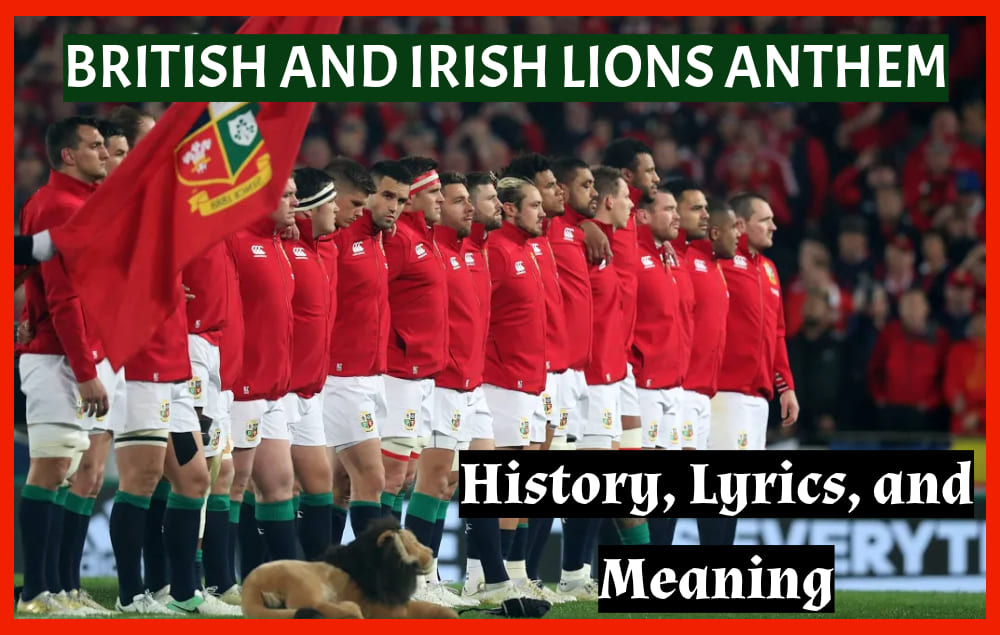
If you’ve ever been in a stadium surrounded by a sea of red, you know what I’m talking about. There’s something almost mystical, a lump in your throat that won’t let you swallow, when the best players from England, Scotland, Wales, and Ireland take the field. But then comes that awkward silence… the moment of the anthem. And that’s where things get interesting. What do you sing when you represent four nations that, for the rest of the year, would “kill” each other on the pitch?
SEE SONG LYRICS
The Power of Four
Compositor: Neil Myers | Año: 2005
| Aspect | Description & musical details |
|---|---|
| 🎼 General technical |
Key: Usually performed in G Major (some choral versions lower to F Major for baritone ease). G Major gives a majestic, heroic brightness. Tempo: Moderate march – ♩ = 92–96 BPM. Ceremonial, not a fast parade march. Time signature: 4/4 (C) – standard quadruple, easy to follow, ideal for stadiums. Texture: Choral polyphony with orchestral accompaniment. Starts slender (solo voices/sections) evolves into massive homophony at the choir. |
| 🎵 Main motif (notes) |
Central theme (union of four nations): ascending melody in G Major. Refrain “From the four cornered world…” approx: G – A – B – C | D – C – B – A | G – B – D – G’ Melodic analysis: uses perfect fourths and fifths – intervals associated with stability, nobility, military character. |
| ⏱️ Time & rhythm |
Anacrusis (pick-up): most phrases begin with a short upbeat before the downbeat → constant forward impulse. March rhythm: dotted eighths + sixteenths frequent in brass/percussion → bouncing but firm, typical of British anthems. Cadences: at the end of each national verse (Ireland, Scotland, Wales, England) a strong Authentic cadence (V–I) closes the idea before the next nation. |
| 🎺 Orchestration & dynamics |
Structural crescendo: begins with solo/small group → ends with full orchestra (heavy brass, strings, timpani) and complete choir at fortissimo (𝆑𝆑). Symbolism: each nation gets slightly different instrumental colour before merging into the common chorus → individuality unites as one team. |
| 🎹 Basic harmony (chorus) |
For keyboard/guitar – harmonic structure of the refrain: I – IV – V – I (G – C – D – G) vi – IV – V (Em – C – D) I – V – I (G – D – G) (all chords in G major) |
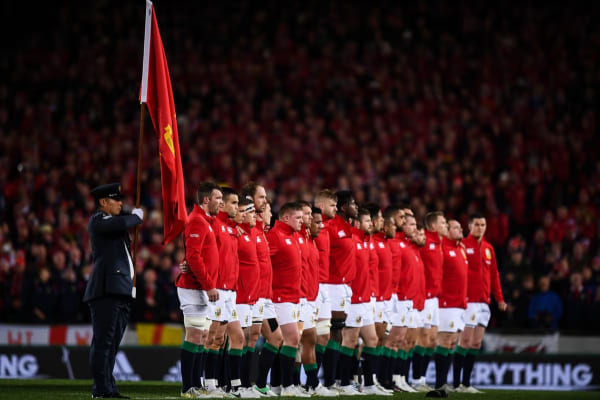
The search for the British and Irish Lions Anthem is, essentially, the most beautiful and frustrating puzzle in rugby. It’s trying to give a single voice to four souls that roar differently.
A Musical “Frankenstein” That Nearly Broke Our Hearts
I remember the 2005 tour of New Zealand. God, what a disaster and what a marvel all at once. Sir Clive Woodward, with his “marginal gains” mentality, decided we needed our own battle cry. They hired Neil Myers, and he gave us “The Power of Four.”
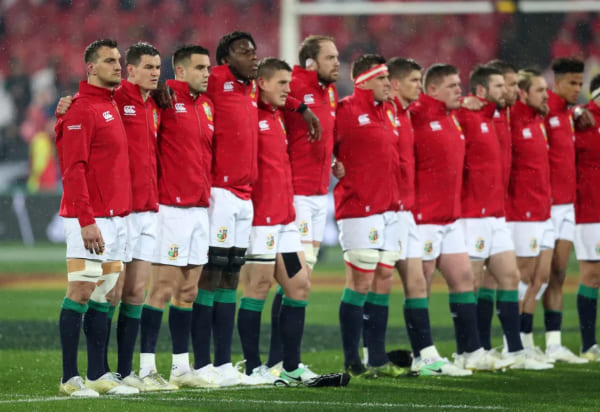
Let’s be honest: the intention was noble. They wanted something to unite us in the face of the All Blacks’ imposing Haka. But when it started playing… phew. It felt like a jingle for a luxury car commercial. Too clean, too orchestral, but without any “grit.”
The lyrics went something like, “From the four corners of our lands… We’re united, hand in hand.” Yes, the message of unity was nice, but five minutes later, you’d already forgotten the melody. The problem? Rugby isn’t marketing; it’s heritage. Trying to manufacture a Lions anthem in a lab is like trying to age fine whiskey in a microwave: it simply doesn’t work.
The Blessed Chaos of Four Nations and Their “Non-Anthem”
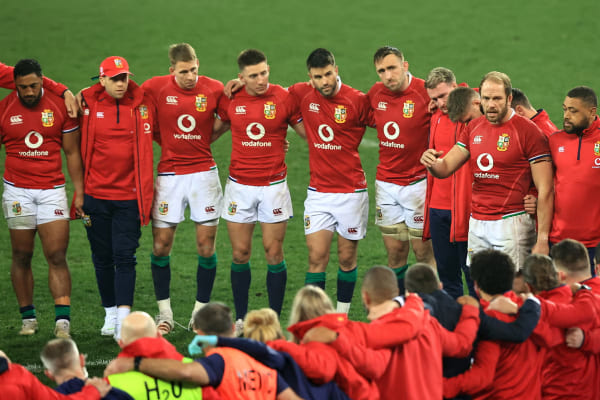
Why is it so difficult to choose a British and Irish Lions anthem? Because we are a wonderful chaos of identities. If you play “God Save the King,” the Scots and Welsh look at you strangely. If you play “Ireland’s Call,” technically you’re only representing one island.
Jeremy Birchall’s “Mashup”: An Emotional Journey
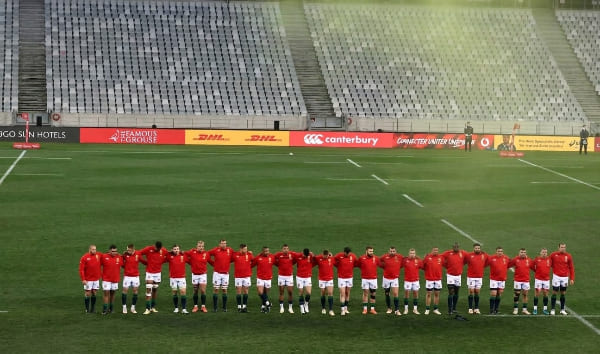
This is where Jeremy Birchall’s choral version comes in. For me, it’s the closest we’ve come to technical and emotional perfection. It’s not a new song; it’s an embrace between old rivals:
- The mystical pride of the Welsh “Hen Wlad Fy Nhadau.”
- The indomitable resilience of “Flower of Scotland.”
- The unifying hope of “Ireland’s Call.”
- And the almost religious solemnity of the English “Jerusalem.”
When you hear those brass instruments and that epic crescendo… wow! It gives you goosebumps. It’s as if all our historical wars dissolved into one giant scrum.
And What About Silence or Spontaneous Singing?
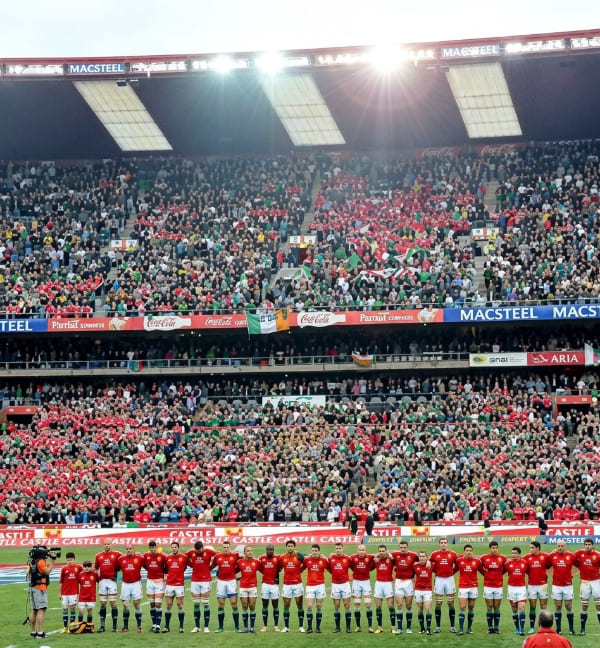
Sometimes I think the best anthem for the British & Irish Lions is, ironically, the one born in the stands, without warning. Have you ever heard 30,000 people singing “Fields of Athenry” in the middle of a South African stadium? That isn’t rehearsed. A paid composer doesn’t write that. That is the soul of rugby exploding organically.
Historic Moments; Where Silence and Song Made History
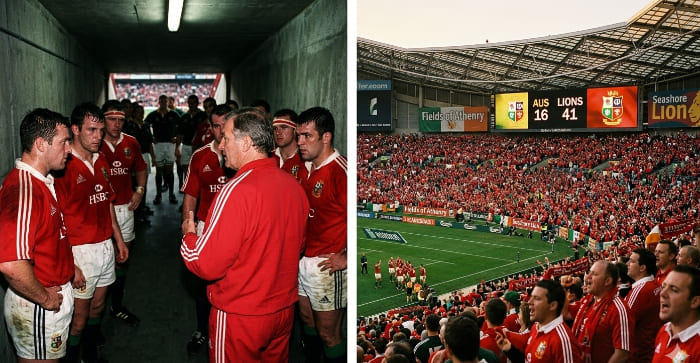
A team’s anthem isn’t always heard through the speakers; sometimes, it’s felt in moments of extreme tension. Here are two instances where music (or its absence) defined the Lions:
- South Africa 1997 and the power of silence: On one of the most iconic tours in history, the Lions didn’t need an official song. The “anthem” was Jim Telfer’s speech and the deathly silence in the tunnel before facing the Springboks. That silence was more frightening for the opponent than any melody composed in a studio.
- Australia 2013 and the red sea: In the third Test Match in Sydney, the stadium became an extension of the British Isles. No official British and Irish Lions Anthem played, but when the fans spontaneously began singing “Fields of Athenry,” the Australian team confessed they felt like visitors in their own home. The people’s music fueled the final 41-16 victory.
The Power of the Intangible: Why We Keep Searching for the Perfect Rhythm
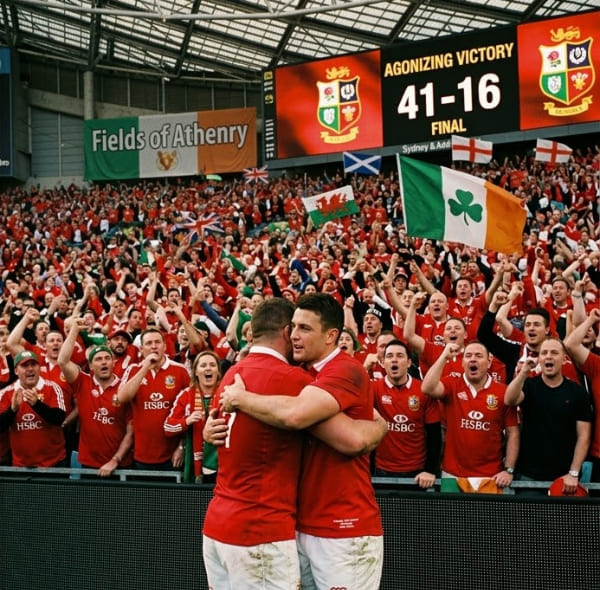
At the end of the day, the anthem of a Lions tour isn’t a score you can buy in a shop. It’s that moment of absolute respect in the tunnel. It’s the sound of studs hitting the concrete.
before heading out to “war.” It’s that moment when an English prop embraces a Welsh fly-half after an agonizing victory.
I know many purists continue to ask for a song we can all shout at the top of our lungs. But between us, I think we’ll never have one “officially” because no lyrics could possibly contain so much history, so much conflict, and so much respect all at once. We are four peoples who decided that, for six weeks, we are just one. And that, my friends, there is no choir in the world that could sing that better than a stadium roaring in a chaotic and free way.