


- What is the difference between rugby and American football? (When I realized I knew nothing)
- Rugby vs American football: how they feel
- The rule that changes everything
- Enhanced Comparison Chart
- If you need to see it to understand it
- The physical factor
- So… which one is better?
- What is the difference between rugby and American football? (Real conclusion)
- Frequently Asked Questions
What is the difference between rugby and American football? (When I realized I knew nothing)
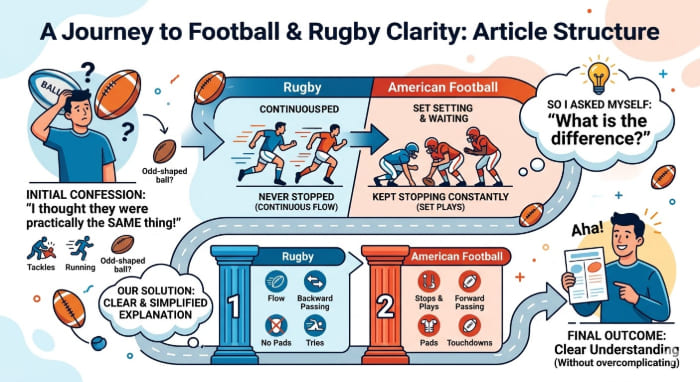
I have a confession to make: for years, I thought rugby and American football were practically the same thing.
Odd-shaped ball, tackles, people running… that was it.
Until one day, I sat down to watch them carefully. And that’s when everything changed. One of them never stopped. The other kept stopping constantly.
So I asked myself: “What is the difference between rugby and American football?”
If you’ve wondered the same thing, keep reading. Here you’ll understand it without overcomplicating things.
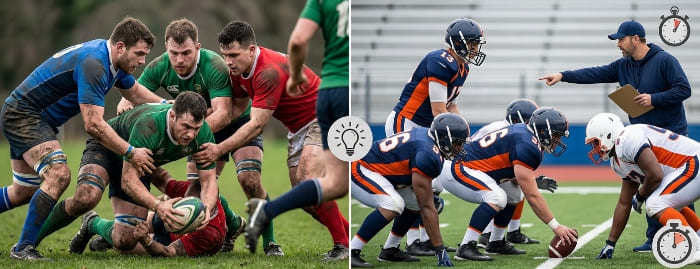
Rugby vs American football: how they feel
Rugby: constant movement
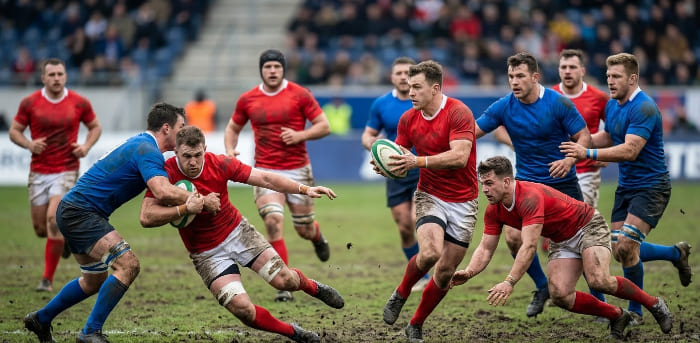
Everything happens instantly.
You fall → you get up.
You lose the ball → you recover it.
Typical reader question: “Why does it seem so disorganized?”
Because the design is fluidity and continuity.
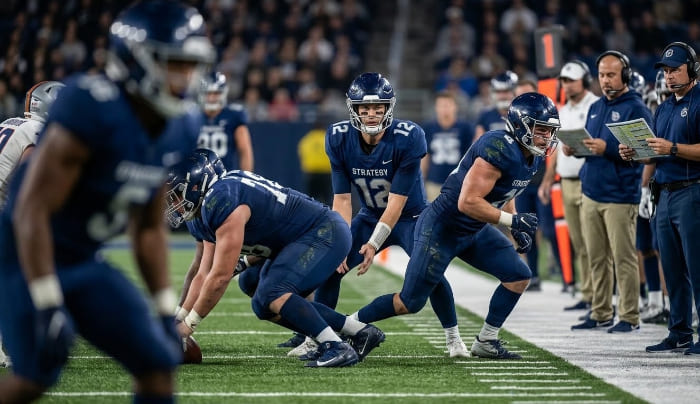
The rule that changes everything
In rugby, you cannot pass the ball forward.
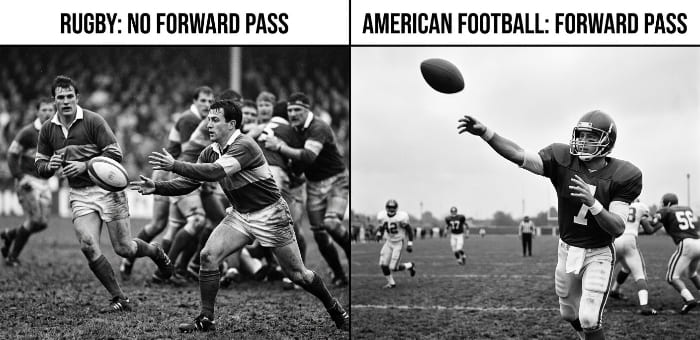
I know, it sounds strange. But it forces you to work as a team, move together, and think quickly.
In contrast, in American football, the forward pass creates spectacular plays and dramatic moments that we all remember.
Enhanced Comparison Chart
| Aspect | Rugby | American Football | What you probably think |
|---|---|---|---|
| Pace | Continuous | Paused | “Why doesn’t one stop?” |
| Passing | Backwards only | Forward allowed | “This doesn’t make sense…” |
| Players | Everyone does everything | Specific roles | “Why do some barely move?” |
| Duration | ~80 real minutes | Much longer in practice | “When does this end?” |
| Style | Chaotic | Strategic | “One seems improvised” |
| Contact | Constant | Explosive | “Which one hurts more?” |
| Equipment | Minimal | Full protection | “Why does one look like armor?” |
| Sensation | Fluidity | Tension | “They feel different” |
Differences in equipment
| Element |
NFL Player (American Football)
|
Rugby Player (Union/League)
|
|---|---|---|
| 🏈 Helmet |
Mandatory
Rigid polycarbonate shell with steel face mask and internal air/foam padding system.
Polycarbonate
Steel
Impact-absorbing foam
|
Optional
“Scrum cap” made of soft fabric and foam. Protects against cuts and abrasions only — no impact protection.
Textile
Soft foam
|
| 🛡️ Shoulder Protection |
Mandatory
Shoulder pads. Hard plastic shell covering shoulders and chest.
Hard plastic
Foam lining
|
Optional
Padded “body armour” shirts with thin foam layers (<1cm thick).
Compression fabric
Thin foam
|
| 🦵 Lower Body Protection |
Mandatory
Pants with built-in pockets for hard plates protecting thighs, knees, hips, and tailbone.
Hard plastic inserts
Reinforced padding
|
None
Cotton or reinforced polyester shorts. No rigid protection whatsoever.
Cotton
Polyester
|
| 🦷 Mouthguard |
Mandatory
Typically attached to the helmet via straps.
Thermoplastic
Silicone
|
Virtually Mandatory
The most important protection — universally worn on the field.
Thermoplastic
Custom molded
|
| 👟 Footwear |
Cleats designed for specific surfaces (natural/artificial). Generally heavier for maximum traction.
Leather/Synthetic
Molded cleats
|
Boots with studs (metal allowed for forwards). Vary by position — designed for pushing or speed.
Leather/Knit
Metal studs
|
| 🧤 Gloves |
Very common. Feature adhesive grip material for better ball reception.
Tackified palm
Synthetic leather
|
Uncommon. Some players wear fingerless fabric gloves with light grip.
Textile
Silicone grip dots
|
If you need to see it to understand it
Sometimes reading isn’t enough.
The physical factor
Both sports are tough:
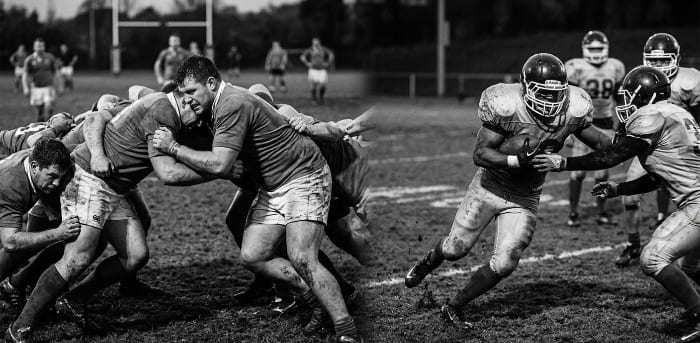
Rugby = endurance and continuity
American football = strength and explosion
Different type of intensity, different sensation. Your body feels it, and so does your heart.
So… which one is better?
There is no universal answer.
Rugby: drags you along with its constant flow
American football: builds tension and then hits you emotionally
It depends on what you’re looking for: continuous action or intense moments.
What is the difference between rugby and American football? (Real conclusion)
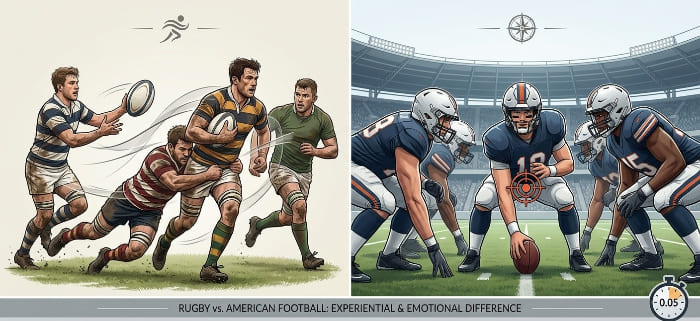
Going back to the initial question:
The difference is not just technical. It is experiential and emotional.
Rugby = movement, fluidity, constant connection
American football = pause, tension, precise execution
One exhausts you naturally, the other keeps you in suspense and anticipation.
And when you see it that way… you no longer confuse them.
Frequently Asked Questions
If you want to explore the historical origins and technical differences in more depth, the Wikipedia comparison of American football and rugby union is an excellent starting point with cross-references and detailed data.