
Motor Neurone Disease (MND) is a progressive, incurable neurological condition that destroys the nerve cells controlling movement. And in the world of rugby both league and union it keeps claiming names that fans know by heart.
This week, Australia was reminded of that in the most brutal way. Jai Arrow, one of the NRL’s most respected forwards, announced his immediate retirement at just 30 years old after receiving an MND diagnosis. He won’t play another game. For Australians who watched him dominate in the maroon of Queensland, the news hit like a freight train.
But Arrow isn’t alone. He joins a growing, heartbreaking list of rugby players league and union, from Sydney to South Africa who have faced this same fight. Here’s everything you need to know: the players affected, the science behind the link, and what the early warning signs actually look like.
Which Rugby Players Have Had MND?
The list is longer than most people realise. When looking closely at how many rugby players have MND, it becomes clear that it spans codes, continents, and generations.
Jai Arrow (NRL) — The Case That Hit Home
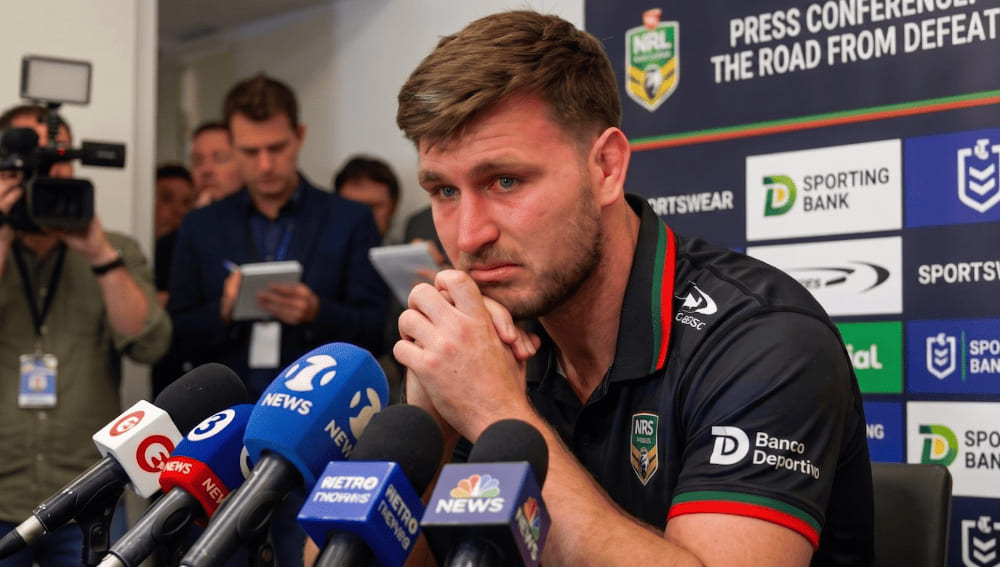
Jai Arrow’s NRL press conference, May 2026
Jai Arrow’s story is the one that has shaken Australian rugby league to its core — right now, today.
The South Sydney Rabbitohs forward played 178 NRL games across three clubs (Brisbane Broncos, Gold Coast Titans, South Sydney Rabbitohs) and was named the Rabbitohs’ player of the year in 2025 — the George Piggins Medal. He represented Queensland in 12 State of Origin matches between 2018 and 2023. He was, by every measure, one of the game’s elite.
In early 2026, Arrow’s shoulder started giving him trouble. The club announced he was undergoing investigations. At the time, nobody said the word MND. In May 2026, the word was said.
At a press conference in Sydney, Arrow stood quietly while Rabbitohs CEO Blake Solly read his statement:
Over recent months, my symptoms have affected different parts of my everyday life. On medical advice, I am not currently medically cleared to train or play.
He asked for privacy. He asked for support — not sympathy. And he walked away from the sport he had given a decade to.
There is currently no cure for MND. Arrow, at 30, now faces that reality.
| Club | Games |
|---|---|
| Brisbane Broncos | 24 |
| Gold Coast Titans | 56 |
| South Sydney Rabbitohs | 98 |
| Queensland (State of Origin) | 12 |
Rob Burrow (Rugby League) — The Man Who Changed Everything
Rob Burrow tribute — Leeds Rhinos memorial, 2024
If Jai Arrow’s diagnosis is the shock of 2026, Rob Burrow’s story is the one that changed how the world understands MND.
Burrow was a scrum-half for the Leeds Rhinos — 5’5″, compact, absolutely electric. He made over 400 appearances for the club across a 17-year career, winning eight Super League Grand Finals, two Challenge Cups, and three World Club Challenges. An extraordinary player.
In December 2019, at just 37 years old and barely two years into retirement, he was diagnosed with MND. He was given two years to live.
He lived for almost five — and in that time, he became something far bigger than a rugby player.
Alongside his former teammate Kevin Sinfield, Burrow raised over £15 million for MND charities. He documented his life with the disease in two BBC documentaries. A dedicated treatment centre — the Rob Burrow Centre for MND — was built in Leeds, opening in 2025. His son Jackson cut the ribbon.
Rob Burrow died on 2 June 2024, aged 41.
His final message, shared after his death: In a world full of adversity, we must still dare to dream.
Sinfield’s tribute was simple: the world had lost a great man and a wonderful friend. That said it all.
MND Association — Rob Burrow’s Legacy
Lewis Moody (Rugby Union) — The World Cup Winner Fighting Back
Lewis Moody BBC Breakfast interview, October 2025
The English rugby player mnd community was stunned in October 2025 when Lewis Moody — 2003 World Cup winner, former England captain, Leicester Tigers legend — announced his own MND diagnosis at 47.
Moody won 71 caps for England between 2001 and 2011. He was the archetypal English flanker: ferocious, relentless, technically brilliant. He was capped for the British & Irish Lions in 2005. He played every match in England’s World Cup campaign in Australia — including the final, where he won the lineout that led to Jonny Wilkinson’s famous drop goal.
His diagnosis began exactly where these things often do: a gym session. He noticed weakness in his shoulder that wouldn’t respond to physiotherapy. A scan revealed nerve damage in his brain and spinal cord.
You’re given this diagnosis of MND and we’re rightly quite emotional about it,” Moody told the BBC, his wife Annie beside him. “But it’s so strange because I feel like nothing’s wrong.
That — right there — is one of MND’s cruelest tricks. The early stages can feel almost invisible, even as the damage accumulates.
Moody described his symptoms at diagnosis as minor: muscle wasting in the hand and shoulder. He said he was still capable of doing “anything and everything.” He is focused on staying positive. The rugby world, to its credit, rallied around him immediately.
As Gloucester rugby player MND discussions emerged—closely following Ed Slater’s MND journey—it’s worth noting Moody finished his career at Bath..
Doddie Weir & Joost van der Westhuizen — Legends Who Paved the Way
Before Burrow and Moody, two men from the rugby union world were already fighting — and raising awareness.
Doddie Weir, the giant Scottish lock and British & Irish Lion, was diagnosed with MND in December 2016 at age 46. He founded the My Name’5 Doddie Foundation in 2017, which has since funded millions in MND research. He described Rob Burrow as his “MND hero.” Weir died in November 2022, aged 52.
Joost van der Westhuizen — the South African scrum-half immortalised in Invictus, the man who tackled Jonah Lomu in the 1995 World Cup final — was diagnosed in 2011. He was given two and a half years. He fought for six, eventually dying in February 2017, aged 45. Before his death, he founded the J9 Foundation and partnered with the University of Edinburgh for MND research. His famous quote after diagnosis: “Why me? It’s quite simple — why not me? If I have to go through this to help future generations, why not me?”
The history of South African rugby players with MND has one clear, devastating answer. Joost. And he faced it with extraordinary courage.
Is MND More Common in Rugby Players?
This is the question the sport has been wrestling with — and exploring whether is MND more prevalent in rugby players reveals a body of research that is becoming increasingly hard to ignore.
A landmark study, published in the Journal of Neurology, Neurosurgery and Psychiatry, examined former Scottish international rugby players and found they were 15 times more likely to develop MND than the general population. Fifteen times.
That number sent shockwaves through the game.
More recently, a 2024 study led by Durham University — published in the International Journal of Molecular Sciences — found that retired rugby players with a history of multiple concussions had significantly elevated levels of proteins called serum t-tau and tau-p181 in their blood. These proteins are directly linked to the development of both Alzheimer’s disease and MND.
The researchers also found lower levels of RBP-4, a protein critical for healthy brain function and development, in concussed players compared to non-contact sport athletes.
A 2023 analysis published in Amyotrophic Lateral Sclerosis and Frontotemporal Degeneration went further: contact sport participation was associated with 76% higher odds of an ALS (MND) diagnosis — particularly when combined with other risk factors.
The mechanism? Researchers are still investigating, but the prevailing theory centres on repetitive head impacts — not just big concussions, but the cumulative effect of thousands of smaller impacts across a career. As Professor Willie Stewart, one of the leading researchers in this field, has noted: “It’s the total lifetime brain trauma that seems to matter most.”
Does this mean every rugby player will get MND? No. The absolute risk remains relatively low. But the relative elevation is real, documented, and growing harder to dismiss.
The sport is responding. The Rugby Football Union has implemented over 70 injury prevention initiatives. World Rugby has changed tackle laws and reduced contact in training. The NRL has updated its concussion protocols. Whether these changes are happening fast enough — that’s a different, more uncomfortable question.
Early Symptoms and Life Expectancy
One of the most insidious aspects of MND is how quietly it begins.
The players profiled here — across league and union, across countries — noticed strikingly similar early signs:
- Muscle weakness in a specific area (shoulder, hand, arm) that doesn’t improve with physiotherapy
- Muscle wasting — visible reduction in muscle mass, particularly in the hands
- Twitching or cramping in muscles
- Fatigue that seems disproportionate to activity
- In some cases, changes to speech or swallowing (in later stages)
Lewis Moody described noticing shoulder weakness at the gym. Jai Arrow referenced symptoms affecting “different parts of everyday life.” Rob Burrow reportedly noticed a slur in his speech — caught, mercifully, by his wife Lindsey.
The challenge: these symptoms are easy to attribute to old injuries, overtraining, or ageing. Which means diagnosis often comes later than it should.
Life expectancy after MND diagnosis:
According to MND Australia and the NHS, average life expectancy following diagnosis is two to five years. However, this varies significantly:
| Prognosis factor | Typical range |
|---|---|
| Average survival post-diagnosis | 2–5 years |
| Faster progression (bulbar onset) | Less than 2 years |
| Slower progression (limb onset) | 5–10 years or more |
| Exceptional cases (e.g., Stephen Hawking) | Decades |
Rob Burrow was told he had two years. He lived four and a half — and made them count more than most people make of a lifetime.
Frequently Asked Questions
Research suggests yes — with significantly elevated risk. A major study of former Scottish international rugby players found them 15 times more likely to develop MND than the general population. Researchers believe repeated head impacts, accumulated over a career, may be a key contributing factor. However, the absolute risk remains low, and MND can occur in people with no sporting history at all.
No single cause has been confirmed, and MND can occur without any contact sport history. However, studies suggest that repetitive head trauma — including sub-concussive impacts — may accelerate neurological damage in some individuals. Research has identified elevated levels of specific proteins (t-tau and tau-p181) in the blood of concussed retired rugby players, suggesting a biological mechanism linking head impacts to neurodegenerative disease. This is an active area of research, not a settled conclusion.
Moody first noticed the symptoms during a gym session, where he experienced persistent weakness in his shoulder that didn’t improve with physiotherapy. He was referred to a specialist, underwent an MRI scan, and scans revealed damage to nerves in his brain and spinal cord. He received his MND diagnosis in October 2025. He has described his early symptoms as minor — muscle wasting in the hand and shoulder — and stated he still feels well in himself.
Geoff Burrow is the father of Rob Burrow, the Leeds Rhinos legend who died from MND in June 2024. Since his son’s diagnosis in 2019, Geoff has become a visible supporter and activist in the MND community, attending fundraising events alongside the Burrow family. The family’s public commitment to raising awareness has been central to the £15+ million raised for MND research in Rob’s name.
The Bigger Picture
There’s a pattern here that’s impossible to ignore. English rugby player mnd. Rugby league player mnd. South African rugby player mnd. NRL player mnd. The names keep coming — and they’re not random. These are people who gave their bodies, their heads, to a sport they loved.
The question isn’t whether to keep playing rugby. Millions of people play the game safely, joyfully, and without consequence. The question is whether the sport — and the people who govern it — are moving fast enough to protect the next generation of Jai Arrows before it’s too late.
For now, the best any of us can do is know the signs, support the research, and hold the ones who are fighting in some decent amount of light.
Jai Arrow asked for support, not sympathy. He deserves both.
For support resources in Australia, visit MND Australia or call the MND Connect helpline.