

Japan Rugby League One is no longer a niche product. 521,040 spectators watched the opening rounds of the 2025–2026 season — a figure that, frankly, would make more than a few European leagues blush. The JRLO has gone from a post-pandemic rebuild project to one of the most compelling professional rugby competitions on the planet in fewer than four seasons.
This is not just growth. This is a structural shift in how Japan consumes rugby.
JRLO Average Attendance: Season-by-Season Evolution
The numbers tell a story that no one in the rugby world saw coming — or at least, not this fast.
When the Japan Rugby League One launched in 2022, replacing the old Top League brand, the conversation centred on whether clubs could retain their corporate identity while appealing to a broader public. The answer has come in waves, each more emphatic than the last.
| Season | Total Attendance | Average per Match | Key Milestone / Highlight |
|---|---|---|---|
| 2022 | ~480,000 | ~9,500 | Inaugural season post-Top League rebranding. |
| 2023-2024 | 1,000,000+ (Combined) | ~11,762 | Total tournament attendance smashed past 1M. |
| 2024-2025 | Under Review / Growing | ~14,200 | Steady increase in regional group fixtures. |
| 2025-2026 | 521,040+ (Mid-season) | ~19,603 | Opening round broke all previous records. |
The jump between 2023–2024 and the current campaign is not incremental — it is seismic. An average of 19,603 fans per match in the opening round is the kind of number that forces people to stop and rethink their assumptions about rugby’s ceiling in Asia.
Top Attendance Records in Japan Rugby History
Some records exist on paper. Others exist in memory.
The Japan Rugby League One Championship Finals — held at the National Stadium in Tokyo (capacity: 68,000) — have consistently drawn crowds north of 55,000 spectators, making them among the best-attended club rugby finals anywhere in the world. For context: a lot of European cup finals would struggle to fill half that.
In regular-season action, clashes between Saitama Wild Knights and Toshiba Brave Lupus Tokyo have repeatedly exceeded 32,000 attendees. These are not showcase exhibition games. These are league fixtures — the kind that in England would attract maybe a quarter of that turnout outside of Premiership showdowns.
And then there is the 2025–2026 opener. An average of 19,603 fans per game across the entire opening round is not a single outlier match. It represents an entire weekend of Japanese rugby operating at a level the sport simply was not at three years ago.
Which JRLO Division 1 Clubs Draw the Largest Crowds?
Not every badge pulls the same weight at the turnstile. The JRLO has its box-office names — and then it has everyone else.
Toyota Verblitz and Saitama Wild Knights are, without much debate, the current kings of attendance. Both clubs have built squads loaded with genuine international stars — not journeymen on farewell tours, but marquee players still in their prime. The result is stadiums that fill up not just for derbies but for mid-table fixtures too.
Yokohama Canon Eagles and Kubota Spears Tokyo Bay sit in the tier below — clubs whose averages are respectable but who tend to reserve their biggest gates for play-off scenarios. The Eagles, in particular, have shown consistent improvement season on season, which suggests their ceiling has not been reached yet.
Toshiba Brave Lupus Tokyo deserves a special mention. Their head-to-head fixtures with the Wild Knights have become appointment-viewing events in Japan — the sort of match that moves the needle on live TV ratings and social media simultaneously.
Factors Driving the Rugby Attendance Boom in Japan
You can point to the data all you want. But data without context is just numbers on a spreadsheet. So — why is this happening?
The Impact of World-Class Marquee Players
The arrival of players like South Africa World Cup winner Cheslin Kolbe — one of the best finishers in global rugby — changed the conversation entirely. When a player of that calibre signs for a Japanese club, it does not just make headlines in rugby media. It reaches mainstream sports culture.
Japan has a deep tradition of respecting elite craftsmanship, whether in martial arts, football or sumo. A world-class rugby player performing at the highest level, week in week out, taps into that cultural value system in a way that generic marketing never could.
The JRLO has understood this. The recruitment of All Blacks, Wallabies, Springboks and Lions players — many still at or near their absolute peak — has turned the league into something genuinely worth watching. The fans have noticed. The turnstiles have followed.
Stadium Experience and Modern Infrastructure
Here is where Japan has a structural advantage that is almost unfair.
Japanese stadium operations are, bluntly, some of the best in the world. The matchday experience — from arrival logistics to food vendors to in-stadium presentation — is executed with a level of precision that most Western clubs would need a decade and a complete organisational overhaul to replicate.
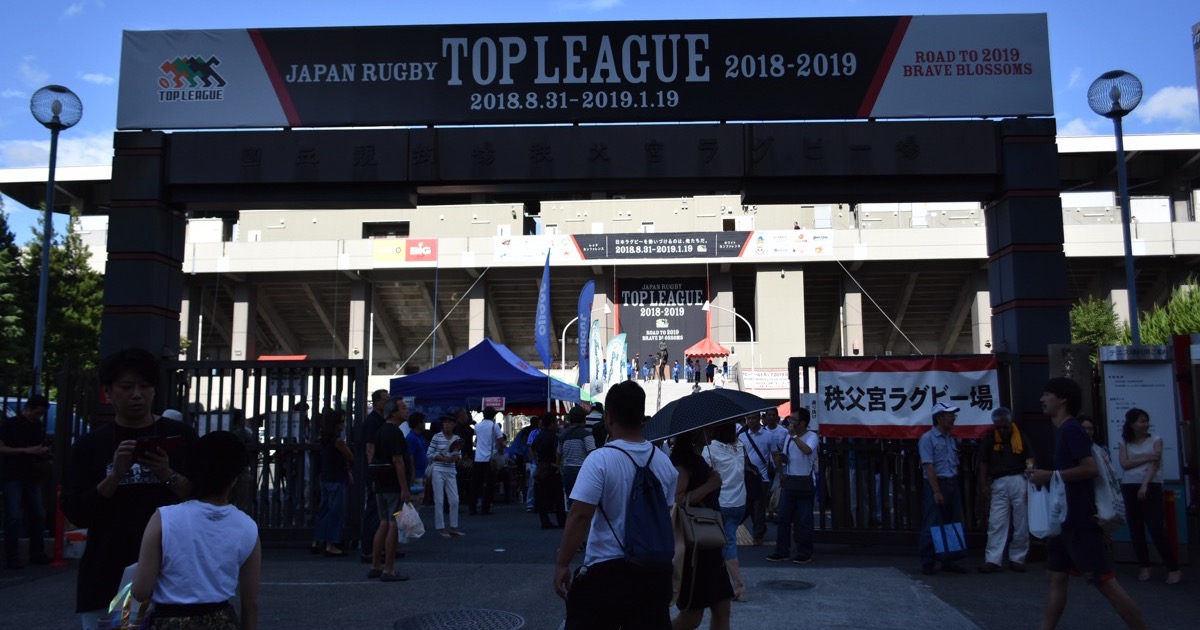
The use of Chichibunomiya Rugby Stadium, the MUFG Stadium and the National Stadium Tokyo offers a range of atmospheres: intimate and loud for regular-season battles, grand and spectacular for finals. This variety matters. It keeps the product feeling fresh across a long season.
FAQ: Japan Rugby League One Crowds & Trends
It depends on the season — and it keeps improving. The 2023–2024 campaign averaged approximately 11,762 fans per fixture across the tournament. By the opening rounds of 2025–2026, that figure had surged to a peak of 19,603 per match. The trajectory is unambiguously upward.
The Japan Rugby League One Championship Finals at the National Stadium in Tokyo hold the league records, routinely attracting crowds of over 55,000 fans. These are not outliers — they are consistent benchmarks set season after season, which speaks to the health of the competition’s top end.
Honest answer: baseball and the J-League still dominate in terms of total fanbase and media real estate. But rugby union — supercharged by Japan’s extraordinary run at the 2019 Rugby World Cup — has carved out a position as one of the fastest-growing professional sports in the country, both in live attendance and broadcast revenue. It is no longer punching below its weight.
The Bigger Picture
There is a version of this story where the JRLO’s growth levels off — where the initial excitement fades, the marquee players age out, and the league settles into modest, stable numbers.
That version looks increasingly unlikely.
The structural investments are real. The talent pipeline is real. The fan engagement data is real. And critically — the 2025–2026 season is already breaking records before it has finished. That is not a fluke. That is momentum with foundations.
For anyone tracking the global evolution of professional rugby, Japan Rugby League One is not a curiosity anymore.
It is a case study.
Reference: For official Japan Rugby League One fixture data and competition structures, visit the official site — the governing body that oversees international rankings, player eligibility and global competition frameworks that directly impact JRLO recruitment and visibility.