
- Who is Ed Slater? The Rugby Career Before July 2022
- The Diagnosis: How Did the Rugby Star Know He Had MND?
- How is Ed Slater Doing Now? A Timeline of Resilience
- The 4Ed Foundation: Turning Diagnosis into a Global Campaign
- Why Do So Many Rugby Players Get MND? The Deep Connection
- Supporting the 4Ed Movement
- Frequently Asked Questions
Ed Slater was forced to retire from professional rugby in July 2022. Not because of a knee. Not because of age. At 33 years old, after six months of medical testing, he was diagnosed with Motor Neurone Disease —a progressive, incurable condition that attacks the nervous system until it silences everything.
But here’s what makes his story different from a tragic headline: Ed Slater refused to go quietly.
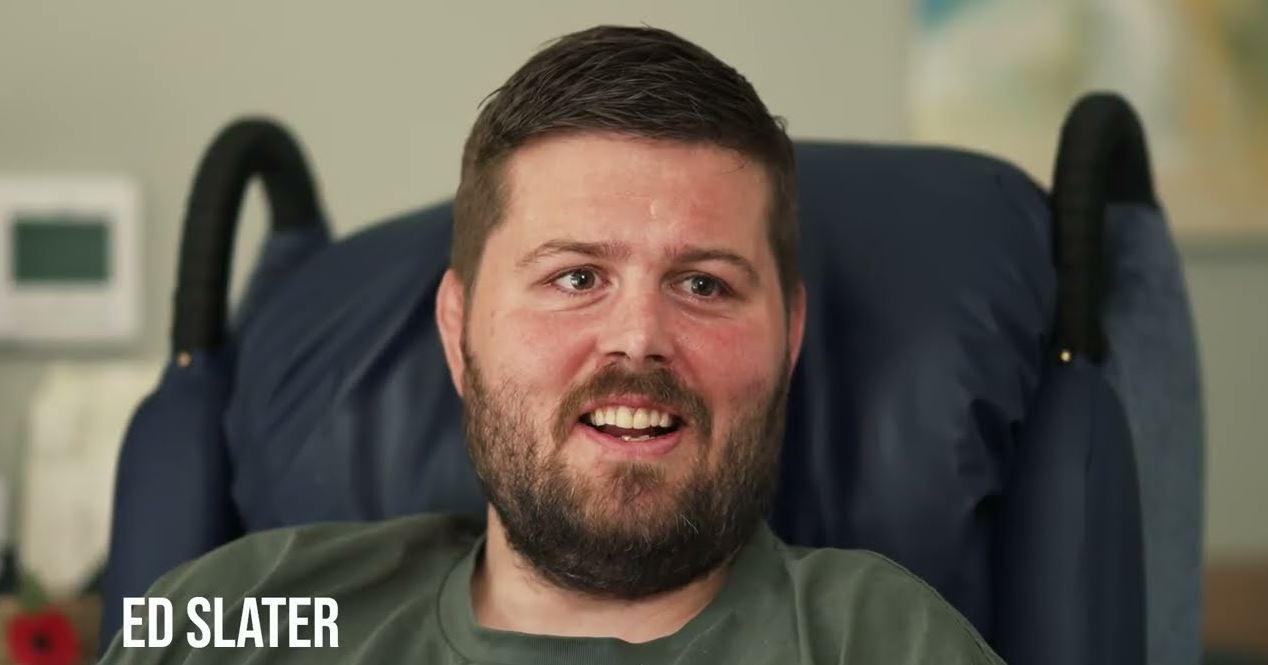
Today, he communicates through an AI-cloned version of his own voice via ElevenLabs, writes deeply personal blog posts under the title “Navigating the Road No One Chooses”, and has built one of the most impactful MND charities in the UK. If you’ve landed here asking “is Ed Slater still alive?” or “what happened to the rugby player with MND?” — you deserve an honest, up-to-date answer. This is it.
Following his diagnosis, he joined a brave group of famous rugby players with MND dedicated to finding a cure and changing player welfare.
Who is Ed Slater? The Rugby Career Before July 2022
Before the diagnosis, Ed Slater was one of English rugby’s most respected locks. Physically imposing, relentless in the lineout, and the kind of captain players ran through walls for.
| Detail | Information |
|---|---|
| Full Name | Edward Nicholas Slater |
| Date of Birth | 1 August 1988 |
| Position | Lock / Flanker |
| Height | 1.98 m (6 ft 6 in) |
| Clubs | Leicester Tigers (2010–2017), Gloucester Rugby (2017–2022) |
| Representative Rugby | England Saxons (4 caps) |
| Career Appearances | ~230 (136 for Leicester, ~90 for Gloucester) |
| Retirement | 21 July 2022, following MND diagnosis |
Born in Leicester but raised in Milton Keynes, Slater didn’t even pick up a rugby ball until he was 16. He was a football kid — a Charlton Athletic fan who’d been mesmerised by the green pitch at The Valley. Rugby came late; it left nothing behind.
He joined Leicester Tigers in 2010, and within three seasons had won a Premiership title. He was named in the Premiership Team of the Year for 2012/13 —the same year he captained the side to glory. He was only 24. From there, he became club captain of the Tigers, toured New Zealand with England, and captained his country against the Crusaders in Christchurch in 2014.
Then came a career-threatening ACL tear in that very same game. Two years of chasing his own form. More injuries. And yet — he stayed. He signed for Gloucester as part of a high-profile swap deal that sent Jonny May to Leicester, and he spent five more seasons as one of the most consistent locks in the Premiership.
That’s who Ed Slater is. A man who spent his entire career getting back up.
The Diagnosis: How Did the Rugby Star Know He Had MND?
The question turns up in searches constantly: “How did Ed Slater know he had MND?”
The answer is that he didn’t — not at first. The symptoms were subtle enough to misread, difficult enough to pin down. What followed was six months of extensive medical testing, the kind of process that leaves you in an agonising no-man’s land between hoping it’s something minor and dreading what it might actually be.
On 21 July 2022, Gloucester Rugby issued a statement that sent shockwaves through the sport:
“Gloucester Rugby is deeply pained to announce that Ed Slater has been diagnosed with MND.”
Ed was 33. He had been in professional sport his entire adult life. And with immediate effect — the same day as the announcement — he retired.
No final match. No lap of honour. Just a diagnosis, a press release, and a new chapter that nobody writes in their plans.
What makes this particularly resonant is the timing: 2022 was also the year Doddie Weir — Scotland and Newcastle Falcons legend, and the first rugby player to publicly champion the MND cause — passed away after a five-year battle. The rugby world was already grieving. It then had to absorb the news about Ed. And Rob Burrow, the Leeds Rhinos icon, was still publicly fighting his own diagnosis, still inspiring millions.
Three players. Three jersey numbers. One brutal disease.
How is Ed Slater Doing Now? A Timeline of Resilience
This is the section most people are really looking for. And it deserves honesty.
MND is progressive. There is no cure. Its trajectory, for most patients, moves in one direction — and Ed Slater is not exempt from that reality.
What we know as of 2025–2026:
- Ed has lost his physical ability to speak.
- He now communicates using an AI-cloned version of his own voice, built through ElevenLabs, the same platform that launched a free voice-preservation initiative for MND/ALS patients in August 2024. The technology allows him to type and have the words read aloud in his voice — a voice his family and community still recognise.
- He uses a motorised wheelchair. At the 2024 745 Game at Headingley, he was photographed courtside in his chair, watching the match he co-conceived. Still present. Still steering.
- He continues to write actively on the 4Ed Foundation blog, posting personal essays that are then read in his AI voice. His January 2025 entry reflects on his move from Leicester to Gloucester in 2017 — not as nostalgia, but as testimony. As of October 2024, he was writing: “I was proud to see the 745 Cross Code Rugby game launched recently. I wasn’t sure if it would remain just an idea between Rob and me, but thanks to…”
Ed’s use of AI voice technology isn’t a gimmick. It’s defiance. It says: you can take the voice, but not the words.
Key milestones timeline:
- July 2022 — MND diagnosis confirmed, immediate retirement announced
- August 2022 — 4Ed Foundation launched; inaugural 350-mile charity cycle from Kingsholm to Welford Road completed within 24 hours by Ed and former teammates
- 2023 — Foundation exceeds initial fundraising targets; grant programme for MND families established
- November 2024 — First ever 745 Game at AMT Headingley Stadium; 10,044 people in attendance
- 2025 — 4Ed surpasses £220,000 in grants awarded to over 100 MND-affected families
- November 2025 — Ed receives an Honorary Fellowship from the University of Gloucestershire at a ceremony at Cheltenham Racecourse
That last one matters. The university cited his “leadership, resilience, and impact beyond sport” — calling him an inspiration to students in the School of Sport and Exercise Sciences. Ed said he was “extremely proud” to receive it. And he should be.
The 4Ed Foundation: Turning Diagnosis into a Global Campaign
Most people, upon receiving a terminal diagnosis at 33, would be forgiven for stepping back. Ed Slater built a charity.
The 4Ed Foundation — the number 4 being his shirt number — was established in the weeks after his diagnosis with a simple, urgent vision: no MND family should face this disease alone, financially or emotionally.
It sits under the Gloucester Rugby Charitable Foundation and functions as a direct-grant organisation. This is not bureaucratic charity-speak. It means that when a family living with MND needs a wheelchair-accessible vehicle, adapted bathroom equipment, or simply a week away together before things deteriorate further — 4Ed tries to make that happen.
What 4Ed delivers:
- Financial grants for essential equipment and home adaptations
- Support for access to medical care
- Funded respite breaks and family experiences
- Community connection for those navigating MND
As of 2025, the foundation has awarded more than £220,000 in grants to over 100 families across the UK. That’s not a rounding figure. That’s 100 conversations nobody wanted to have, followed by 100 families receiving practical help when they needed it most.
The 4Ed Foundation has also organised a Race to the Slater Cup cycle event and multiple fundraising partnerships — building an ecosystem of support around a disease that affects roughly 5,000 people in the UK at any given time.
Ed’s Honorary Fellowship from the University of Gloucestershire in 2025 recognised this work specifically. The fact that he received it in a wheelchair, communicating through an AI voice, only adds weight to what the award represents.
Why Do So Many Rugby Players Get MND? The Deep Connection
This is the question that hangs over the sport — and it deserves a straight answer, even if the science is still catching up.
A landmark 2022 study published in the Journal of Neurology, Neurosurgery and Psychiatry examined 412 former Scottish international rugby players and found they were 15 times more likely to develop MND than the general population. Not 15% more likely. Fifteen times. The same study found they were twice as likely to develop dementia, and more than three times as likely to develop Parkinson’s disease.
That figure caused a sharp intake of breath across the sport.
Then, in July 2024, research led by Durham University — part of the UK Rugby Health project — found that retired rugby players with a history of multiple concussions showed higher levels of tau proteins in their blood: the same proteins associated with the development of both Alzheimer’s disease and MND. They also showed reduced levels of a retinoid transport protein crucial to brain function.
The researchers were careful. Correlation is not causation. But the signals are hard to ignore.
“It’s the total lifetime brain trauma that seems to matter most.” — Professor Willie Stewart, University of Glasgow
The hypothesis — still under active investigation — is that repeated microtraumatic head impacts, compounded over a decade or more of professional contact sport, may trigger biological changes that make the brain more susceptible to neurodegenerative disease. Not just the big concussions. The weekly, grinding, “that’s just part of rugby” impacts that nobody called an injury.
For further reading on this critical research, the MND Association maintains a detailed summary of the evidence: mndassociation.org
The Three Names the Sport Cannot Forget
You cannot discuss Ed Slater and MND without acknowledging the two men who walked this road alongside him.
Doddie Weir OBE — the towering Scotland lock diagnosed in 2016, who refused to hide his illness and instead wore his tartan flamboyantly to every public appearance until his death in November 2022. Weir founded My Name’5 Doddie Foundation and, more than almost anyone, forced the rugby world to look at what MND actually was. He was the trailblazer.
Rob Burrow CBE — Leeds Rhinos legend, diagnosed in 2019. Forty-one years old when he died in June 2024. A man who, despite losing his speech early in the disease’s progression, spent years appearing publicly alongside his friend Kevin Sinfield — running marathons, raising millions, changing policy. The Rob Burrow Leeds Marathon has become one of the UK’s most emotionally significant running events.
Ed Slater knew both men. He learned from Doddie. He planned a rugby match with Rob. And he carried the torch when both were gone.
The 745 Game: A Match Born in a WhatsApp Chat
The jersey numbers: Rob Burrow wore 7. Ed Slater wore 4. Doddie Weir wore 5.
The idea started as a WhatsApp conversation between Rob and Ed — two men living with MND, imagining a charity game that could bring rugby union and rugby league together for the first time in a meaningful way. Rob passed away in June 2024 before the idea became a reality. Ed made sure it happened anyway.
On 17 November 2024, at AMT Headingley Stadium in Leeds — Rob’s home ground — the first ever 745 Game took place. A hybrid of both codes’ rules, refereed by officials from both games wearing Doddie Weir’s unmistakable tartan. Former stars including Danny Cipriani, Ben Youngs, Adrian Morley, Mike Tindall, and Danny McGuire took the field. Rob Burrow’s daughters Macy and Maya, alongside Ed’s daughters Edie and Flo, led the two teams out.
10,044 people turned up.
Rugby League won 33–21. Nobody cared who lost.
The second 745 Game took place on 9 November 2025 at Kingsholm Stadium — Ed’s home ground — broadcast live on TNT Sports. It is now an annual fixture. All funds are split between 4Ed, the Rob Burrow Discretionary Fund, and My Name’5 Doddie Foundation.
What started in a group chat became a national institution in two years. That’s what happens when grief gets organised.
Supporting the 4Ed Movement
Ed Slater can no longer speak in the way he once could. But his voice — the real one, cloned into software, typed onto a screen — continues to reach people. His blog entries are acts of radical honesty. His foundation is delivering tangible help to families who have nowhere else to turn.
If you’ve read this far because you cared enough to search for him, the most useful thing you can do is visit 4-ed.co.uk and find out how to support the foundation — whether through a donation, a fundraising event, or simply sharing the work that Ed and his team are doing.
MND takes so much. The least we can do is make sure fewer families face it alone.
Frequently Asked Questions
Is Ed Slater still alive?
Yes. As of 2026, Ed Slater is alive and continues to be actively involved with the 4Ed Foundation. He has lost his ability to speak physically but communicates through an AI-cloned voice and continues to write personal blog posts.
When was Ed Slater diagnosed with MND?
Ed Slater’s MND diagnosis was confirmed following six months of medical testing and announced publicly on 21 July 2022, the same day he announced his immediate retirement from professional rugby.
What is the 4Ed Foundation?
The 4Ed Foundation is a charity established by Ed Slater following his MND diagnosis. It provides financial grants to families living with MND, covering equipment, home adaptations, medical care access, and family respite experiences. It has awarded over £220,000 to more than 100 families.
What is the 745 Game?
The 745 Game is an annual charity rugby match combining union and league rules, named after the shirt numbers of Rob Burrow (7), Ed Slater (4), and Doddie Weir (5). The first game was held in November 2024 at Headingley. Proceeds are split between 4Ed, the Rob Burrow Discretionary Fund, and My Name’5 Doddie Foundation.
Why do rugby players get MND more often?
Research suggests former professional rugby players are up to 15 times more likely to develop MND than the general population. Scientists have identified elevated levels of tau proteins linked to neurodegeneration in players with multiple concussion histories, though a direct causal link has not yet been definitively established.
His case has frequently been cited alongside the latest scientific research regarding rugby and neurological diseases and safer training loads.
Reference:
- 4Ed Foundation (official): https://4-ed.co.uk
- MND Association UK: https://www.mndassociation.org
- 745 Game official: https://www.745game.org
- My Name’5 Doddie Foundation: https://www.myname5doddie.co.uk