
- The Impact of Motor Neurone Disease on Springbok Legends
- Prominent South African Rugby Players Diagnosed with MND
- Quick Reference: South African Rugby Players Affected by MND
- Rugby and MND: What Does the Medical Science Say?
- The UK Connection: United in the Fight Against MND
- FAQ: Frequently Asked Questions about Rugby and MND
- Final Thoughts
When South African rugby fans think about the Springboks and motor neurone disease (MND), one name comes to mind: Joost van der Westhuizen. And that’s the problem. Because Joost wasn’t alone. Not even close.
Since 2011, at least four prominent South African rugby players have been diagnosed with MND — also known as amyotrophic lateral sclerosis (ALS) — a progressive, incurable neurological disease that destroys the nerve cells controlling movement, speech, and eventually breathing. Four players. In a single sporting community. That’s not coincidence. That’s a pattern.
This article compiles everything known about the South African rugby players affected by MND, examines what the science says about rugby’s relationship with neurodegenerative disease, and connects their struggle to a global movement that now spans hemispheres — from Johannesburg to Leeds.
The global rugby community has rallied together as more rugby players diagnosed with MND share their stories to fund life-changing research.
The Impact of Motor Neurone Disease on Springbok Legends
Motor neurone disease attacks the nerve cells — the motor neurones — that carry signals from the brain and spinal cord to the muscles. The result is progressive muscle weakness, paralysis, and, ultimately, death. There is no cure. The average life expectancy after diagnosis is two to five years, though some patients, like Joost himself, defy those odds for years.
The disease does not discriminate by fitness, athleticism, or youth. It took men who had spent their lives conditioning their bodies to peak performance and left them trapped inside those same bodies.
What makes the South African rugby cases so striking isn’t just the number — it’s the timeline. Multiple diagnoses arrived within a short window, affecting players from overlapping eras and provinces. It prompted serious questions, none of which have fully comfortable answers yet.
Prominent South African Rugby Players Diagnosed with MND
Joost van der Westhuizen: The Legendary Captain’s Greatest Battle
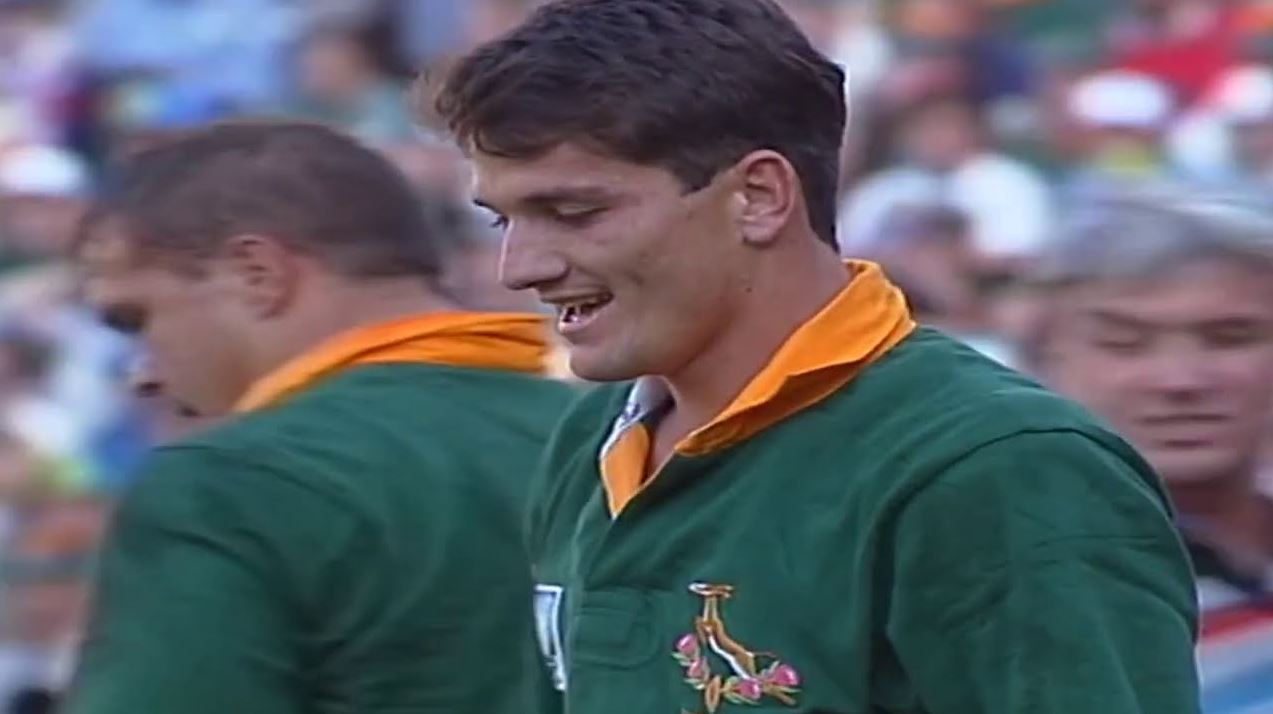
Born on 20 February 1971 in Pretoria, Joost van der Westhuizen is remembered as one of the greatest scrum-halves in rugby history. His try-saving tackle on Jonah Lomu in the 1995 Rugby World Cup Final remains one of the most iconic moments in the sport — the man who stopped a freight train in its tracks, then helped the Springboks lift the trophy at Ellis Park, in the year South Africa’s post-apartheid story was still being written.
He earned 89 caps for South Africa between 1993 and 2003, scoring a then-record 38 tries. A one-club man with the Blue Bulls. A captain. A symbol.
In early 2011, a close friend who was also a doctor noticed weakness in Joost’s arm. Tests confirmed the worst: amyotrophic lateral sclerosis. His neurologist gave him a 20% chance of surviving two years. He was 39 years old.
What followed was remarkable — not the illness itself, but his response to it. Rather than retreat, Joost launched the J9 Foundation (j9foundation.co.za), a charity dedicated to raising awareness, funding research, and supporting MND sufferers and their families. He travelled globally from his wheelchair, communicating through a computer when his voice failed, turning his own diagnosis into a platform.
He died on 6 February 2017, at home surrounded by family, aged 45. He had lived nearly seven years beyond his initial prognosis. His mind, by all accounts, remained sharp and determined until the end.
“Joost fought a hard seven years with a failing body whilst his mind remained unaffected.” — J9 Foundation official statement
Tinus Linee: Another Heavy Blow to South African Rugby
Marthinus “Tinus” Linee was born on 23 August 1969 in Paarl, a town in the Western Cape that has produced more than its share of rugby talent. He was a centre — physical, combative, and renowned across South African rugby for a ferocity in defence that bordered on legendary. His tackles weren’t just technically sound; they were bone-crunching announcements.
He played 112 matches for Western Province between 1992 and 2001, was part of three Currie Cup-winning squads (1997, 2000, 2001), and earned Springbok selection for nine tour matches across Australia, Wales, Scotland, and Ireland in 1993–94. He never earned a Test cap — one of those cruel quirks of a career spent behind equally talented rivals — but his respect within the game was never in question.
In April 2013, Linee was diagnosed with MND. The same disease that had already claimed Joost van der Westhuizen’s health two years earlier. The Western Province rugby community rallied around him — financially and emotionally — but the disease progressed relentlessly. A ventilator installed in April 2014 stabilised his condition temporarily. His hands, however, remained virtually paralysed.
Tinus Linee died on 3 November 2014, in his family home in Paarl. He was 45 years old.
When Joost heard the news, he posted on Twitter: “Sad day for Rugby in SA. Just received news of the passing of a rugby legend and MND Warrior Tinus Linee RIP my friend #J9Foundation.”
Notably, the Western Province team doctor at the time, Francois Majoos, also contracted MND and died shortly afterwards — a detail that quietly intensified the mounting sense of alarm within South African rugby circles.
Danny Delport: The Heartbreaking Fourth Diagnosis
If Joost’s diagnosis was a shock, and Tinus Linee’s a second devastating blow, the news about Danny Delport in January 2015 was — as the headlines at the time phrased it — South African rugby being “rocked.”
Delport had played as a winger for Natal Sharks in the early 1970s, studying at Maritzburg University before returning to his native Rhodesia (now Zimbabwe) and representing the national team for eight years. A career that spanned continents and eras, and one that had faded quietly into memory long before the diagnosis arrived.
By 2015, Delport was 62 years old, settled in Perth, Australia with his family since 2008. When the news broke that he had been diagnosed with MND the previous year, it emerged he wasn’t even the third case. He was the fourth.
Between Joost (2011), Tinus Linee (2013), Sharks scrum-half Ryan Walker (diagnosed 2013, aged just 34 after 15 months of tests), and now Delport — the pattern had become impossible to ignore.
His situation was compounded by the fact that his wife Sue was simultaneously battling severe osteoporosis, leaving the family facing enormous physical and financial challenges on the other side of the world. Friends back in South Africa established a “Danny’s Support Initiative” to help. The rugby community, to its credit, showed up.
Quick Reference: South African Rugby Players Affected by MND
| Player | Teams Represented | Year of Diagnosis | Outcome / Legacy |
|---|---|---|---|
| Joost van der Westhuizen | Blue Bulls, Springboks | 2011 | Died February 2017 (aged 45). Founded J9 Foundation. |
| Ryan Walker | Natal Sharks | 2013 | Diagnosed aged 34 after 15 months of tests. |
| Tinus Linee | Western Province, Stormers, Springboks (tour) | 2013 | Died November 2014 (aged 45). |
| Danny Delport | Natal Sharks, Rhodesia | 2014 | Diagnosed aged 62 in Perth, Australia. |
Aside: The Western Province team doctor of that era, Francois Majoos, also contracted MND — a detail rarely noted in mainstream coverage but one that adds further weight to the cluster.
Rugby and MND: What Does the Medical Science Say?
Here is where the conversation gets uncomfortable — and where it matters most.
For years, the link between contact sports and neurodegenerative disease was treated as anecdote. Correlation, not causation. Then the studies started arriving, and the numbers became hard to dismiss.
Research published in 2022 — examining Scottish international rugby players — found they were 15 times more likely to develop MND than the general population. That figure, reported widely across UK sports media, did not arrive quietly.
More recently, a 2024 study led by Durham University’s UK Rugby Health Project analysed the blood of 30 retired rugby players with significant concussion histories. The findings showed elevated levels of proteins called serum t-tau and tau-p181 — the same biomarkers associated with Alzheimer’s disease and MND — compared to a control group of athletes with no head trauma history. These players also showed lower levels of RBP-4, a protein critical to brain development and function.
The key phrase from the lead researcher, Professor Willie Stewart of the University of Glasgow: “It’s the total lifetime brain trauma that seems to matter most.” Not a single catastrophic concussion. Not even necessarily the collisions that leave players visibly dazed on the pitch. The cumulative weight of thousands of ordinary impacts — scrums, tackles, rucks — across a career spanning a decade or more.
This is the paradigm shift. And it’s still unfolding.
To be precise: science has not yet established direct causation. Researchers are careful to say the studies show association, not proof. Genetic factors, lifestyle variables, and environmental exposures all remain part of a complex picture. But the statistical signal is too strong to be dismissed, and the MND Association UK is actively funding research — including the T-MND study led by Professor Stewart at the University of Glasgow — to explore the traumatic brain injury link further.
World Rugby has responded. More than 70 injury prevention initiatives have been introduced by the Rugby Football Union, tackle height laws have been progressively lowered, and elite women’s players now wear smart mouthguards to measure head movements. Progress, yes. Sufficient? Many in the scientific community would say: not yet.
The question hanging over the sport is this — and it deserves to be asked plainly: if you had known, would the training methods have changed sooner?
The UK Connection: United in the Fight Against MND
There is something quietly extraordinary about the way MND has connected rugby players across codes, continents, and eras.
In the UK, two names have come to define the disease’s intersection with rugby. Doddie Weir — the towering Scotland lock who won 61 caps — was diagnosed with MND in 2016. He set up the My Name’5 Doddie Foundation, raised millions for research, and became — in the words of Rob Burrow — “a beacon of light.” He died in November 2022, aged 52, still fundraising.
Rob Burrow — the Leeds Rhinos scrum-half, a mirror image of Joost in position and spirit — was diagnosed in 2019, just two years after retiring from a 17-year career at Headingley. Alongside his friend and former teammate Kevin Sinfield, he raised more than £15 million for MND charities. He died in June 2024, aged 41, having spent nearly five years transforming national consciousness around the disease.
Similar to the advocacy seen in South Africa, UK figures like Ed Slater have used their platform to unite international teams for the cause.
What’s notable — and under-reported — is the direct bridge between the South African and UK struggles. Joost visited Edinburgh in 2013, where he was met with standing ovations at Murrayfield and forged a research collaboration with the Euan MacDonald Centre at Edinburgh University. The Scottish rugby community that he had spent years trying to defeat on the pitch embraced him wholly.
Joost’s J9 Foundation, Doddie’s My Name’5 Doddie Foundation, Rob Burrow’s work with the MND Association — these aren’t separate campaigns. They are chapters in the same story.
Rugby’s MND warriors have something in common beyond their diagnosis: they all chose to fight outward, not inward. They turned individual tragedy into collective momentum. That’s not inevitable. It’s a choice. And each of them made it.
FAQ: Frequently Asked Questions about Rugby and MND
Which South African rugby players had motor neurone disease?
The most prominent cases are Joost van der Westhuizen (diagnosed 2011, died 2017), Tinus Linee (diagnosed 2013, died 2014), Ryan Walker (diagnosed 2013), and Danny Delport (diagnosed 2014). Western Province’s team doctor Francois Majoos was also affected, making the cluster particularly striking.
What is the J9 Foundation?
The J9 Foundation was established by Joost van der Westhuizen after his MND diagnosis in 2011. Its mission is to raise awareness of motor neurone disease, fund scientific research, and support patients and their families. The “J9” refers to Joost’s jersey number — 9 — the scrum-half’s position he wore for South Africa throughout his career.
Is there a proven link between rugby and MND?
Studies — including a 2022 analysis of Scottish international players and a 2024 Durham University blood biomarker study — suggest former rugby players face significantly elevated MND risk. However, science has not yet established direct causation. The MND Association UK, My Name’5 Doddie Foundation, and MND Scotland are funding research to clarify the relationship. The current scientific consensus is that repeated head trauma is a probable contributing factor, not a proven sole cause.
Final Thoughts
The stories of Joost van der Westhuizen, Tinus Linee, Danny Delport, and Ryan Walker are not simply sporting tragedies. They are data points in a conversation the world of rugby has been reluctant to fully open — and which it can no longer afford to delay.
Science is catching up. Biomarkers are being identified. Protocols are being changed. Foundations are funding research that may eventually — eventually — yield a treatment, or even a cure.
In the meantime, the J9 Foundation continues its work. The My Name’5 Doddie Foundation presses on. And somewhere in the crossover between a Springbok scrumhalf in Pretoria, a Scotland lock in the Borders, and a rugby league legend in Leeds, a global movement is taking shape — built not on institutional momentum, but on the stubborn insistence of dying men that their illness should mean something beyond themselves.
That is a legacy worth more than any World Cup medal.
For more information and support regarding MND, visit the MND Association UK — the leading authority on motor neurone disease research and patient support in the United Kingdom.