
- Is MND Common in Rugby Players? Understanding the Real Risk
- Why Are So Many Sportsmen Getting Motor Neurone Disease?
- Famous Rugby Players Diagnosed with Motor Neurone Disease
- The 2024 Durham University Breakthrough: Pre-Symptom Detection
- What is the Rugby Community Doing to Fight MND?
- Frequently Asked Questions
There is no public record. There is no official census. No one has counted—with clinical precision—how many rugby players have been diagnosed with motor neurone disease throughout history.
But science does have a number. And that number changes everything.
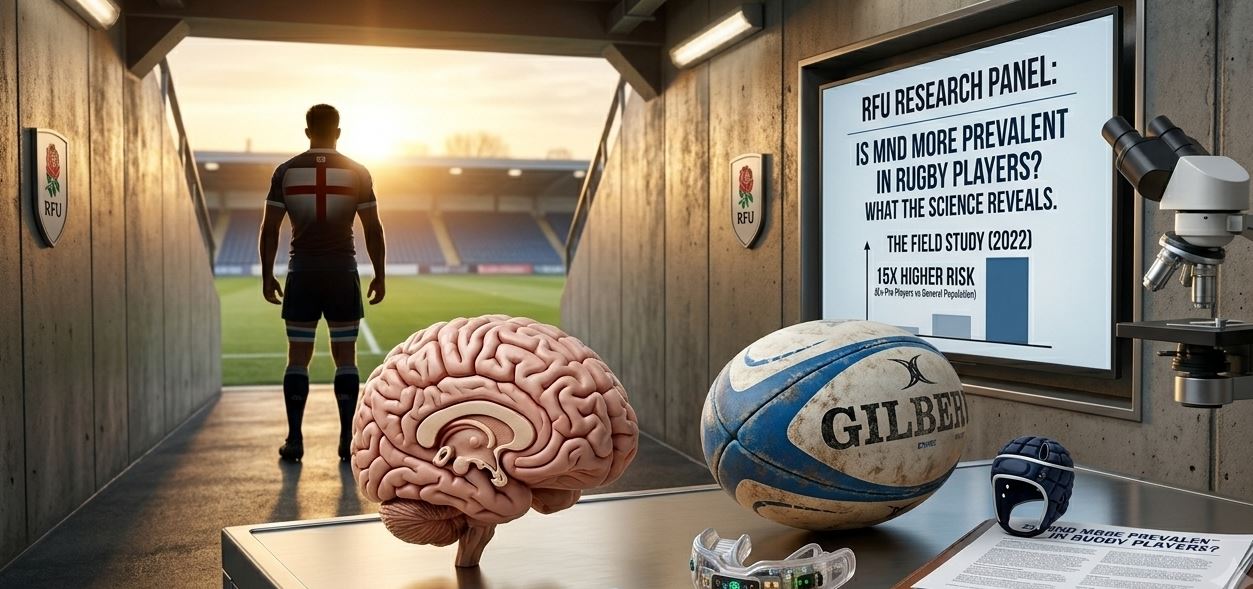
Former professional rugby players are 15 times more likely to develop MND than the general population. That statistic —published in a landmark 2022 Glasgow University study— hit the sport like a tackle it never saw coming. Since then, the conversation has not stopped.
Understanding the connection between rugby and Motor Neurone Disease requires a careful look at documented cases over the past few decades.
Is MND Common in Rugby Players? Understanding the Real Risk
The honest answer is: rare, but not as rare as it should be.
Dr. Willie Stewart and his team at the University of Glasgow spent years analysing the long-term health outcomes of former professional rugby union players in Scotland. What they found was a pattern that could not be explained by chance: former players showed significantly elevated rates of neurodegenerative disease —MND, dementia, Parkinson’s— when compared to matched controls from the general public.
The research became a watershed moment for the sport.
But before the headlines create unnecessary panic, one crucial distinction needs to be made.
Relative Risk vs. Absolute Risk: The Number That Scares, and the One That Reassures
Relative risk is the comparison between two groups. Rugby players have 15x the relative risk of MND compared to non-players. That sounds —and genuinely is— alarming.
Absolute risk is a different calculation entirely. MND affects approximately 2 in every 100,000 people in the UK annually. Even multiplied by fifteen, the individual lifetime risk for a rugby player remains statistically low in absolute terms.
This is not a reason to dismiss the Glasgow data. Not even close. It is, however, a reason to read it clearly —which most media coverage has failed to do.
The MND Association is consistent on this point: a risk factor is not a sentence. Genetics, lifestyle, environment, and individual biology all interact in ways that science is still mapping.
Why Are So Many Sportsmen Getting Motor Neurone Disease?
Rugby is not the only sport with a problem here. It is simply one of the most visible.
American football has been confronting CTE —Chronic Traumatic Encephalopathy— for over a decade, largely thanks to the NFL’s public battles with the science. Traditional football has its own growing dataset, with multiple studies connecting heading and long-term neurodegeneration. The thread connecting all of these sports is identical: repeated blows to the head.
Repetitive Head Injuries and Concussions: The Biology of Damage
The brain was not designed for repeated collision. Each concussion, and arguably each sub-concussive impact that goes unreported and untreated, triggers a neurochemical cascade that the body struggles to resolve cleanly.
The key mechanism involves a protein called TDP-43. When brain tissue is repeatedly traumatised, TDP-43 misfolds —it clumps, accumulates, and begins interfering with normal neuron function. In some individuals, over enough time, those changes become permanent. The neurons begin to die.
This is the biological story that links tackle sport to MND. It is not speculation. It is emerging, replicable science.
Worth repeating, though: not every rugby player who takes a hit will develop this disease. The pathway exists —but most people who walk it do not reach the destination.
The Combination of Elite Exercise and Genetics
There is a second variable that rarely gets the attention it deserves.
The MND Association has flagged this directly: the extreme, sustained physical demands of elite professional sport —compounded by years of repetitive training and competition— may interact with specific genetic predispositions to act as a biological trigger.
Exercise itself is not the enemy here. But the body of a professional rugby player is operating at physiological extremes that the average human never approaches. And that, apparently, matters.
The science is still evolving. Anyone who claims certainty in either direction is operating beyond the evidence. Treat such claims accordingly.
Famous Rugby Players Diagnosed with Motor Neurone Disease
They did not choose to become the faces of a disease. None of them signed up for that particular role.
But in stepping forward publicly —with dignity, with humour where they could find it, and with extraordinary courage— these athletes transformed MND from a condition that most British people had never heard of into a cause that moved a nation.
| Player Name | Rugby Code / Team | Diagnosis Year | Impact & Legacy |
|---|---|---|---|
| Rob Burrow | Leeds Rhinos (League) | 2019 | Raised millions for the Leeds MND Centre; his friendship with Kevin Sinfield became one of British sport’s defining modern stories. Died June 2024. |
| Doddie Weir | Scotland / British & Irish Lions (Union) | 2017 | Founded My Name’5 Doddie; drove unprecedented clinical trial funding. His tartan suits became iconic. Died November 2022. |
| Ed Slater | Gloucester / Leicester Tigers (Union) | 2022 | The first active professional to speak publicly about a mid-career diagnosis; retired immediately. His openness changed the conversation around current players. |
| Joost van der Westhuizen | South Africa (Springboks) | 2011 | One of the greatest number nines the game has ever seen. Created the J9 Foundation; lived publicly with MND for six years until his death in 2017. |
Doddie Weir deserves a paragraph of his own.
When sorting these records by country, a significant number of high-profile cases involve South African rugby players, highlighting a regional concern.
A man whose presence filled rooms —6’5″, loud, laughing, impossible to ignore— he received his diagnosis in 2017 and responded by doing what Scottish rugby forwards have always done when the odds are against them: he pushed harder. His My Name’5 Doddie Foundation has raised millions. The clinical trials it has helped fund are ongoing. The awareness it created is measurable in real funding decisions.
He died in November 2022, but the foundation he built is still accelerating research. That is a legacy that will outlast the disease.
The 2024 Durham University Breakthrough: Pre-Symptom Detection
This is where the story changes direction. Where it stops being purely about grief and starts being about prevention.
Research from the UK Rugby Health Project at Durham University has identified something genuinely new: former rugby players with a documented history of concussions show abnormal levels of specific neurological blood biomarkers —proteins associated with early-stage neurodegeneration— years before any physical symptoms of MND appear.
Read that again slowly.
Before muscle weakness. Before speech difficulties. Before a clinical diagnosis is even possible. The biological warning signs are already detectable in the blood.
The implications are profound. If detection is possible years earlier, the intervention window expands dramatically. Early access to emerging treatments, clinical trials, lifestyle adjustments, specialist support —all of it becomes possible at a stage when it can make a genuine difference.
Most coverage of rugby and MND is still catching up with this. This research is the most important development in this space in years.
For further detail, the UK Rugby Health Project at Durham University publishes its methodology and ongoing findings directly.
What is the Rugby Community Doing to Fight MND?
The answer —and this deserves to be said clearly— is: more than most sports have ever done for a single cause.
Kevin Sinfield is the most visible example. Rob Burrow’s former Leeds Rhinos captain and closest friend has, since 2020, completed a series of ultra-marathons and extreme fundraising challenges that have collectively raised millions for MND research and care. His 7 in 7 challenge —seven marathons in seven days— captured a nation that was starved of stories worth believing in.
There is no commercial motive. No sponsorship-driven narrative. Just a man running impossible distances because his mate is dying and he refuses to stand still.
On the structural side, World Rugby has introduced regulatory changes to tackle height, lowering the legal contact zone in both international and youth rugby. The logic is straightforward: fewer head-on-head collisions means fewer concussions means fewer long-term neurological consequences.
These are not perfect solutions. The culture of the sport, the pressure to play through injury, the inadequacy of concussion assessment in real-match conditions —these problems have not been solved. But the direction is right, and the pace is accelerating.
Frequently Asked Questions
Does getting a concussion mean you will get MND?
No. A concussion is a risk factor, not a verdict. Developing MND requires a complex interaction of genetic predisposition, environmental exposure, and —potentially— repeated neurological trauma over time. The vast majority of people who sustain concussions never develop the disease.
What is the life expectancy after an MND diagnosis?
The typical prognosis is 2 to 5 years from diagnosis. However, progression varies significantly. Stephen Hawking lived for more than 50 years after his first symptoms. Joost van der Westhuizen lived publicly with MND for six years. These are outliers —but they are real, and they matter for how patients and families process what they’re facing.
Which rugby position carries the highest risk of head trauma?
The available data consistently points to back-row forwards and centres as the positions with the highest frequency of high-impact contact events per match —both in terms of carries, tackles, and ruck involvement. These are not positions for the faint-hearted under normal circumstances. Under these circumstances, the stakes are considerably higher.
If you or someone you know has been affected by MND, the MND Association is the UK’s primary resource for patients, families, and healthcare professionals —offering specialist advice, care networks, and pathways to clinical trials.