

- The Numbers: What Did the Landmark FIELD Study Find?
- Why Rugby? Concussions and the Blood Protein Breakthrough
- Relative Risk vs. Absolute Risk: Putting the Danger into Perspective
- The Human Legacy: British Rugby Heroes Fighting MND
- Changing the Game: How Rugby Is Evolving to Protect Players
- FAQs: Frequently Asked Questions about Rugby and MND
- A Final Thought
Yes — and the numbers are staggering. Research from the University of Glasgow confirms that former elite rugby players face over 15 times the risk of developing Motor Neurone Disease (MND) compared to the general population. That figure is not a typo. But before alarm takes hold, there is something crucial to understand: “15 times more likely” sounds terrifying in isolation. In absolute terms, MND remains a rare condition. The distinction matters — and this article unpacks both sides with care.
The ongoing medical debate surrounding rugby MND players has sparked intense investigation into whether elite athletes face a higher risk.
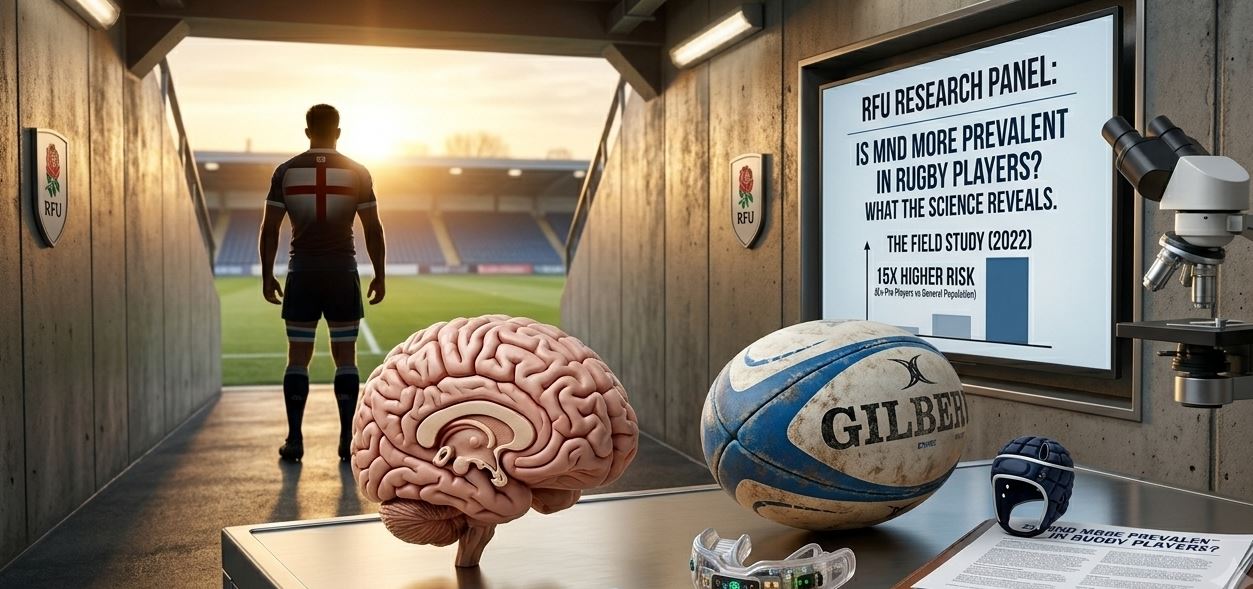
The Numbers: What Did the Landmark FIELD Study Find?
A study led by the University of Glasgow examined lifelong health outcomes among former international rugby union players, representing the largest investigation of its kind into neurodegenerative disease risk in this group.
The research was led under the FIELD programme — the same groundbreaking initiative that previously examined neurodegenerative risk in former professional footballers. This time, the spotlight shifted to rugby. The results were striking.
Researchers found that a group of former international rugby players faced roughly two and a half times the expected risk of neurodegenerative disease overall — and over 15 times the risk of specifically developing MND — when compared to the general population.
Key findings at a glance:
- The study compared 412 former Scottish internationals (born between 1900 and 1990) against over 1,200 non-players matched for age, location, and socioeconomic status.
- Former players were twice as likely to receive a dementia diagnosis.
- Former players were more than three times as likely to develop Parkinson’s disease.
- The MND risk — over 15 times higher — was the most alarming finding, and higher even than that observed in former professional footballers.
- Player position had no impact on dementia risk, suggesting the risk is not confined to forwards who engage in scrums but distributed across the squad.
Professor Willie Stewart, who led the research, described the MND figures as of particular concern, calling for immediate research attention to explore the specific association between rugby and this devastating condition.
The question that naturally follows: why rugby specifically? The answer lies — quite literally — in the blood.
While researchers analyze the neurological mechanisms, looking at the exact statistics on how many rugby players are affected provides a clearer picture.
Why Rugby? Concussions and the Blood Protein Breakthrough
In July 2024, researchers at Durham University published findings that brought the science one important step forward. Not in terms of confirming the risk — that was already established — but in beginning to explain the mechanism behind it.
Retired rugby players who had suffered multiple concussions during their careers were found to have elevated levels of certain proteins in their blood, which may make them more susceptible to developing diseases such as MND.
Think of it like a biological alarm system. Every time the brain suffers a significant impact, it releases specific molecular signals — distress flares, if you will. In a healthy brain that experiences the occasional knock, those signals fade. But in a player who absorbs hundreds or thousands of impacts over a career? Their blood samples showed greater indication of neural damage compared to a control group of athletes who had not suffered head trauma.
Researchers specifically identified elevated levels of proteins called serum t-tau and tau-p181, which play a crucial role in the development of both Alzheimer’s disease and MND.
These proteins are not vague indicators. They are the same markers increasingly used in clinical trials for neurodegenerative disease treatments. Their presence — in elevated quantities, years after retirement — suggests that repeated head impacts leave a molecular footprint that does not simply disappear when a player hangs up their boots.
The research, published in the International Journal of Molecular Sciences, was the first study to explore a range of specific biomarkers as part of the UK Rugby Health Project. As Professor Paul Chazot from Durham University’s Department of Biosciences explained, this work gives scientists the beginnings of a “biomarker toolbox” — a way to periodically monitor the brain health of retired contact sport athletes, particularly those with a concussion history.
A critical nuance worth noting: MND Scotland’s Director of Research clarified that this study does not directly indicate that repeated concussions increase the chance of an individual developing MND, since there are currently no MND-specific biomarkers — the proteins monitored reflect general neurodegeneration rather than MND specifically. Science, as ever, demands precision. The proteins are a signal. The full story is still being written.
Relative Risk vs. Absolute Risk: Putting the Danger into Perspective
This is the section most articles skip — and it is, arguably, the most important one.
When a headline declares that rugby players face “15 times the risk” of MND, it is describing relative risk: how the risk in one group compares to another. What it does not tell you is the starting point.
The lifetime risk of developing MND in the general population is approximately 1 in 300. That is the baseline. So when rugby players face 15 times that risk, the absolute risk still remains within a relatively small range — though it is unquestionably elevated, and unquestionably worthy of urgent attention.
The table below illustrates why both figures matter:
| Concept | Definition | Rugby Context |
|---|---|---|
| Relative Risk | How many times more likely one group is to develop a condition | Former elite players are ~15× more likely to develop MND than non-players |
| Absolute Risk | The actual probability of developing the condition | General population lifetime risk: ~1 in 300; elevated in rugby players but still a minority outcome |
| Why it matters | Headlines use relative risk; it sounds alarming without context | MND remains uncommon even among former players — but the increase is real and demands investigation |
This is not an exercise in minimising a genuine concern. The risk elevation is real, statistically robust, and demands action. But responsible science communication means presenting both dimensions. A former player reading this deserves accurate information — not panic, and not false reassurance either.
The Human Legacy: British Rugby Heroes Fighting MND
Statistics tell one story. People tell another — and it is the one that stays with you.
Three names, in particular, have given MND a face in British rugby. Their courage has done more for awareness and research funding than any academic paper could achieve alone.
Doddie Weir — the larger-than-life Scotland lock who won 61 caps — was diagnosed with MND in 2016. Rather than retreating from public life, he turned his diagnosis into a platform. He wore tartan suits to Murrayfield. He laughed when the rest of us might have wept. Through his My Name’5 Doddie Foundation, he raised more than £8 million for MND research. He died in November 2022, aged 52. The sport has not been the same since.
Rob Burrow — the diminutive but ferociously competitive Leeds Rhinos scrum-half — was diagnosed in 2019. He described Doddie as his “MND hero,” the person whose attitude showed him how to face the unthinkable. He passed away in June 2024, leaving behind what Prime Minister Rishi Sunak called an inspiration to everyone who met him or heard his story. His friend and former team-mate Kevin Sinfield ran seven ultra-marathons in seven days in his honour. The fundraising was staggering. The friendship was something else entirely.
Ed Slater — the former Gloucester and Leicester Tigers lock — was diagnosed in 2022 and retired immediately. The bond between all three men was eventually honoured through “The 745 Game” — named after Burrow’s number 7, Slater’s number 4, and Weir’s number 5 — a charity match combining Rugby League and Union legends, raising funds split three ways to support the MND community.
Burrow himself noted that Weir “inspired millions of pounds of fundraising that has turned the course of research.” That is not an exaggeration. The visibility these men brought to MND has directly influenced research funding, government pledges, and the urgency with which scientists approach the rugby-MND link.
Their legacy is not just human. It is scientific.
Changing the Game: How Rugby Is Evolving to Protect Players
Here is the question most coverage ignores: what is actually being done about it?
The answer — and it deserves saying plainly — is more than sceptics might expect, and less than advocates would like. But the direction of travel is clear.
Smart mouthguards. World Rugby became the first sports governing body to implement instrumented mouthguard technology into its Head Injury Assessment protocol, with the technology integrated from January 2024. The mouthguards are fitted with micro-sensors that measure the force and acceleration in the head during collisions, feeding real-time data to medical teams on the touchline. If the numbers cross a defined threshold, the player is flagged for assessment. It is an imperfect system — the thresholds are still being calibrated — but it represents a genuine step toward quantifying what was previously guesswork.
Lower tackle laws. The RFU introduced a ban on tackling above the waist in community rugby, citing consistent evidence that higher contact between players’ heads is associated with larger head impacts and increased concussion risk. The change applies across clubs, schools, colleges, and universities, as well as lower professional tiers. It is, frankly, a significant rule change — and one that would have been unthinkable a decade ago.
Mandatory monitoring in training. World Rugby’s 2024 updated Head Impact Monitoring Programme now requires mandatory use of instrumented mouthguard technology to measure head impact exposure in elite rugby — not just in matches, but in training sessions where head impacts might occur. A player who fails to comply during training is restricted from accessing the Head Injury Assessment on match day.
These are not cosmetic changes. They signal a sport grappling — seriously, if belatedly — with what the science is telling it.
FAQs: Frequently Asked Questions about Rugby and MND
Does rugby directly cause MND?
Not in a simple, one-to-one sense. Research indicates that former international rugby players face an increased risk of developing MND compared to the general population, with traumatic brain injuries identified as a potential contributing factor. However, MND is a complex condition — genetics, environment, and individual biology all play a role. Repeated head trauma appears to be a significant risk factor, not a guaranteed cause.
Are all sportsmen more prone to MND?
A number of scientific publications indicate there may be an increased risk of developing MND among people who participate in elite-level sport, including football and rugby. However, elite rugby — with its combination of repeated high-impact collisions over a long career — currently shows one of the highest relative risk elevations observed in any sport. The risk is not uniform across all physical activity; recreational exercise at a moderate level does not carry the same concern.
What are the early signs of MND in athletes?
MND symptoms can be subtle at first. They commonly include unexplained muscle weakness (particularly in the hands, feet, or limbs), muscle stiffness or cramping, slurred speech, difficulty swallowing, and problems with coordination or balance. Athletes who notice persistent, unexplained changes in these areas — especially those with a history of concussions — should consult a neurologist promptly. Early identification matters, even though treatment options remain limited.
A Final Thought
The science here is uncomfortable. Nobody enters rugby expecting to carry a 15-fold elevated risk of a fatal neurological disease into retirement. And yet — here we are. The data from Glasgow is robust. The protein findings from Durham are illuminating. The stories of Doddie, Rob, and Ed are heartbreaking in their clarity.
What the evidence does not support is despair. Rugby is changing. Research is accelerating. And the awareness that Weir, Burrow, and Slater built — through sheer force of personality, courage, and an almost baffling refusal to be defined by their diagnosis — has genuinely moved the needle.
The game owes them more than a charity match. It owes them a safer sport.
References and medical and scientific studies based on:
MND Association – Sport and MND — Official overview of the sport-MND link, updated regularly.
Durham University – Blood Protein Research (2024) — Full press release on the biomarker study.
University of Glasgow – FIELD Study — The source of the landmark rugby MND risk data.
World Rugby – Player Welfare & Smart Mouthguards — Official announcement of the 2024 protocol changes.