
- When a Giant Knocks on Westeros's Door
- Who Did Peter Claffey Play Rugby For? Teams and Trajectory
- Peter Claffey Physical Stats: Height and Weight on the Pitch
- Why Did Peter Claffey Quit Rugby? The Turning Point
- From Scrums to Westeros: How Rugby Prepared Him to Play Ser Duncan the Tall
- Quick FAQs About Peter Claffey
- The Athlete Who Dared to Change the Game
When a Giant Knocks on Westeros’s Door
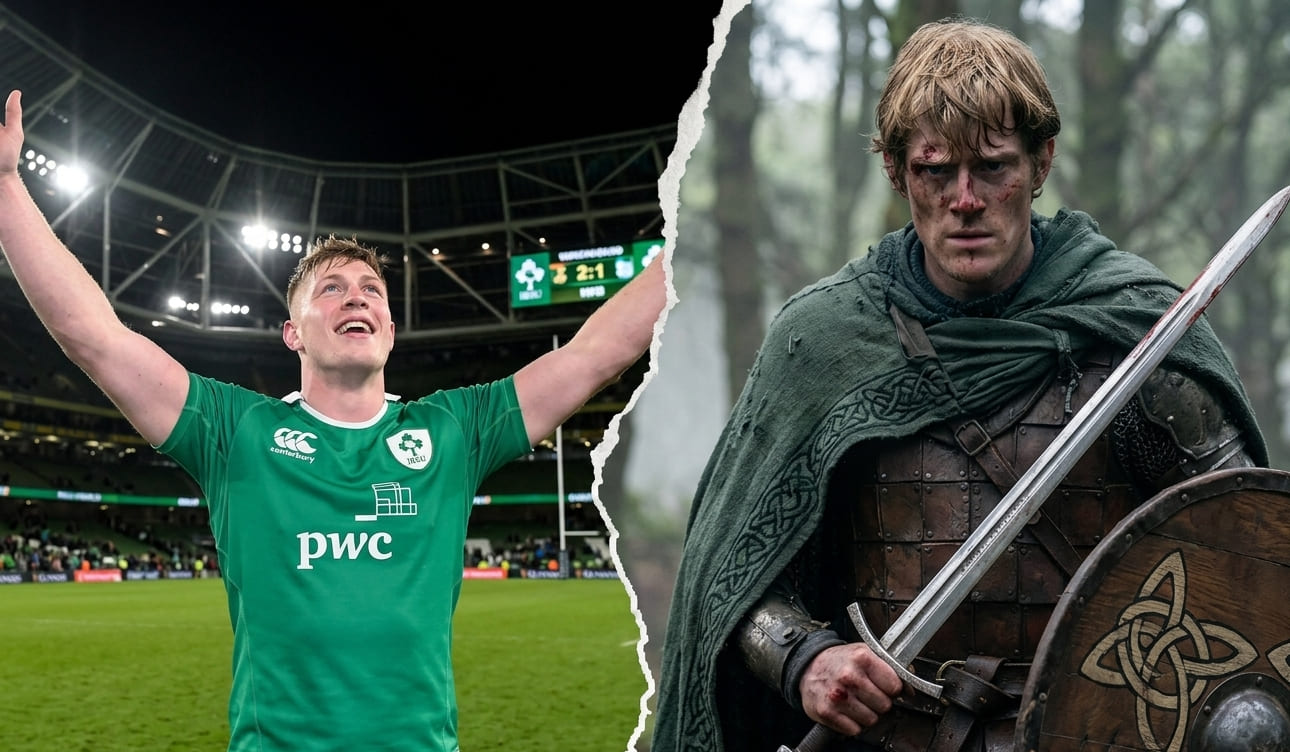
Just weeks ago, millions of Game of Thrones fans discovered Peter Claffey in the leading role of Ser Duncan “Dunk” the Tall in A Knight of the Seven Kingdoms—the long-awaited spin-off that debuted on HBO in early 2026. His towering 1.96-meter frame didn’t go unnoticed. What did surprise many: before George R.R. Martin praised him, Claffey was already a professional Lock in Irish rugby.
The question that invaded Twitter, Reddit, and WhatsApp group chats among fans was instant: Is it true he played rugby? Why did he quit? Yes, it’s completely true. And the story is more interesting than you’d imagine.
Who Did Peter Claffey Play Rugby For? Teams and Trajectory
His journey through rugby wasn’t that of a meteoric star, but of an athlete who tried—with all the determination of a Stark—to conquer Irish professionalism.
Schoolboy Rugby at Garbally College: The First Hits
It all began where most Irish rugby players start: at Garbally College, in Portumna, County Galway. This isn’t just any school. Garbally is practically a talent factory, with a century-old tradition that has produced internationals and professionals.
Claffey stood out. His height was already evident at 15 years old, and his coaches quickly saw he had the potential to play in the second row—the position that defines modern rugby in line-outs.
Club Rugby: Galwegians RFC and Buccaneers RFC
After Garbally, Claffey moved through Ireland’s semi-professional rugby circuit. He played for Galwegians RFC and Buccaneers RFC—two historic clubs in western Ireland, but off the radar of the major professional powerhouses.
At this stage, the picture was clear: either you advanced quickly to a professional academy, or rugby became something you did on weekends while working elsewhere.
Claffey chose to advance.
The Connacht Rugby Academy & Professional Contract: The Breaking Point
In 2015, Claffey received the invitation every Irish rugby player dreams of: the chance to join the Connacht Rugby Academy—one of the four professional provincial academies in Ireland (alongside Leinster, Munster, and Ulster).
The deal was official for the 2018-2019 season. At 22 years old, Peter Claffey was a professional rugby player. He was training with athletes competing in the PRO14 (now URC), the most demanding competition in the northern hemisphere.
But this is where the story takes an unexpected turn.
International Honors: Ireland U20—The Thwarted Pride
Representing your country, even in junior categories, is an honour few achieve. In 2016, Claffey made the Ireland U20 squad for the Six Nations—a platform where players like Dan Sheehan and Jimmy O’Brien later launched themselves toward elite professionalism.
More was expected. An injury along the way robbed him of participation in that year’s U20 World Championship—a tournament where the future stars of world rugby are forged.
Peter Claffey Physical Stats: Height and Weight on the Pitch
| Attribute | Peter Claffey | Average Professional Lock | Context |
|---|---|---|---|
| Height | 1.96 m (6 ft 5 in) | 1.93 – 1.97 m | Top tier height |
| Weight | ~115 kg (253 lbs) | 110 – 120 kg | Optimal for his height |
| Position | Lock / Second Row | — | Core position in rugby |
| Line-out Speed | Explosive | Critical | His primary weapon |
| Wingspan | Exceptional | — | Advantage in ball capture |
Why Height Was His Greatest Asset
A Lock—second row in rugby parlance—is essentially a specialist in line-outs (throw-ins from the sideline). When the ball goes out of play, your team throws it in from the touchline and your Locks jump to catch it.
At 1.96 metres, Claffey had an obvious advantage: literally, he reached further. In professional rugby, two or three centimetres can mean 40% additional possession in a match.
Beyond that, his presence in the maul (defensive cluster) was intimidating. With his weight properly distributed, he was difficult to dislodge from contact areas.
Why Did Peter Claffey Quit Rugby? The Turning Point
Here comes the question that receives hundreds of Google searches every week. And the answer is more human—more real—than any catastrophic injury or media drama.
In 2019, Peter Claffey retired.
The Reality of Semi-Peripheral Professionalism
Connacht Rugby, though a professional club, doesn’t have the same budget or visibility as Leinster or Munster. This means contracts are shorter, more competitive, and opportunities to debut for the first team depend on other players’ injuries or tactical changes.
Claffey never debuted with the first team. He spent his seasons in lower categories, training at maximum but without the reward of match time. The academy gives you stability, but paradoxically, it can also become a stagnation point.
There comes a moment when you have to ask yourself: Is this what I want to do for the rest of my life? For me, the answer was no.
Claffey chose a different path: acting.
The Leap to Bow Street Academy
He enrolled at Bow Street Academy in Dublin, one of Ireland’s most respected acting institutions. It wasn’t a leap into the void—his physical presence, his discipline, and his ability to accept criticism (qualities forged by rugby) were precisely what he needed.
The decision was brave. In 2019, few ex-rugby players made this move. Most stayed, waiting, until they were 30. Claffey chose to start from scratch.
From Scrums to Westeros: How Rugby Prepared Him to Play Ser Duncan the Tall
The casting for A Knight of the Seven Kingdoms in 2024-2025 was exclusive. According to set sources, George R.R. Martin personally insisted that the actor playing Dunk had to be physically imposing—not just tall, but with the presence of someone who’d spent years on a rugby pitch.
Claffey wasn’t chosen for his height. He was chosen because his body told the story of a warrior.
Power Training: The Rugby Legacy
Professional rugby is perhaps the most brutal sport in the modern world (alongside American football). Every training session includes:
- Extreme cardiovascular endurance: Ninety minutes of constant movement.
- Explosive strength: Repeated contacts at maximum power.
- Pain tolerance: Learning to play injured, taped up, injected.
- Mental presence under stress: Making decisions in 2 seconds while someone tries to break your neck.
Claffey carried all of that in his physical DNA when he arrived in Westeros.
Dunk on Screen: The Perfect Role
Ser Duncan “Dunk” the Tall is a poor knight, a man of action who carves his way through tournaments and conflicts. He’s not an actor of complex dialogue (though Claffey is competent). He’s a physical interpreter—someone who communicates through his body.
In fight scenes, in movements within medieval armour, in how he occupies space—that’s where rugby did its work. Martin was open in praising his “imposing stature” and his “credibility as a man of action.”
The irony is perfect: he quit rugby to act, but it was rugby that made him a great actor.
Quick FAQs About Peter Claffey
In Portumna, County Galway, Ireland. A small town where rugby is religion.
1.96 metres (6 ft 5 in) and approximately 115 kilograms (253 lbs). Professional Lock measurements.
Lock (Second Row). Specialist in line-outs and mauls.
In 2019, after failing to debut with Connacht’s first team, he decided to pursue his true passion: acting. He enrolled at Bow Street Academy in Dublin.
No. He retired completely in 2019 to pursue his acting career.
He is the lead in A Knight of the Seven Kingdoms, the Game of Thrones spin-off, playing Ser Duncan “Dunk” the Tall.
Yes, he was part of the Ireland U20 squad for the Six Nations in 2016.
The Athlete Who Dared to Change the Game
Peter Claffey’s career is not the epic story of someone who “had it all.” It’s something rarer: the story of someone who had one door open—professional rugby—and chose to close it to open another.
In a sport where loyalty is almost religion, where leaving the pitch is seen as failure, Claffey was brave. He didn’t wait to be cut. He didn’t spend years in academies waiting for opportunities that never came.
He asked himself what he wanted, listened to the answer, and acted.
Now, millions of people watch him every week on HBO as Ser Duncan. And every time they see him jump to catch an imaginary ball—those movements he made instinctively in line-outs—they’re watching years invested in Irish rugby pitches.
That, for us, is his true victory.