
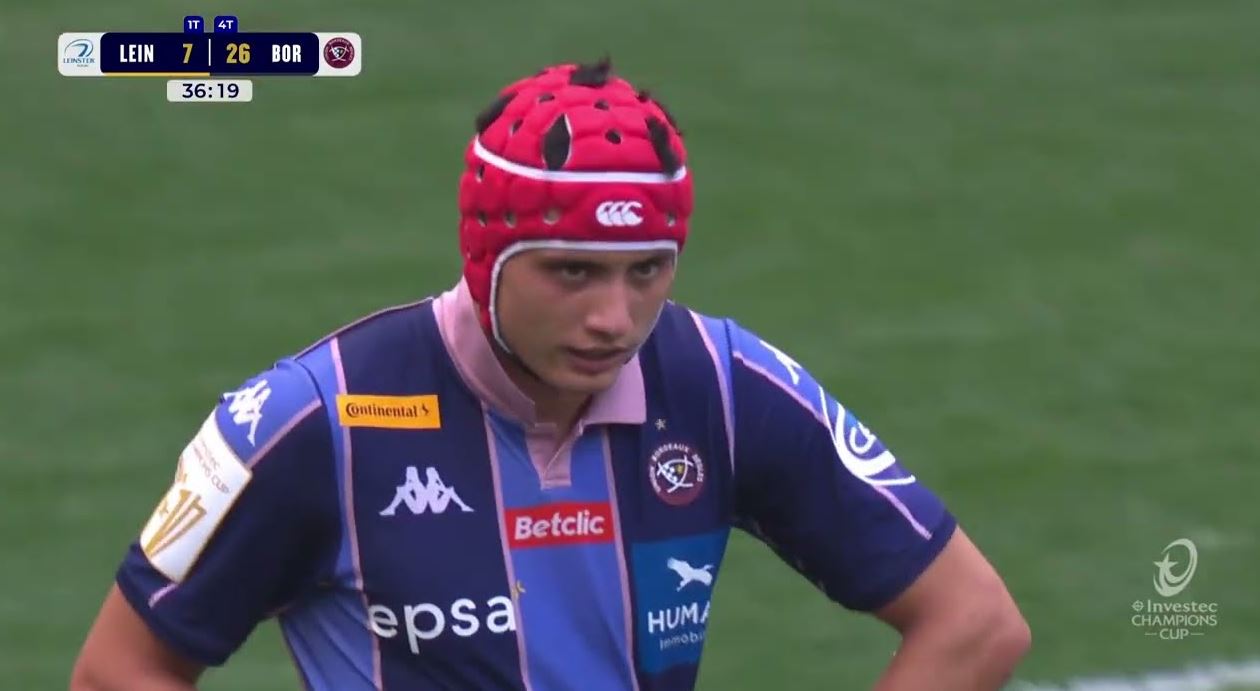
Leinster lost the 2026 Investec Champions Cup final 41-19 to Bordeaux-Bègles at San Mamés Stadium in Bilbao. The core reason was brutally simple: the Irish province collapsed in the opening 40 minutes, conceding five tries and 35 points —a first half that buried any hope before the half-time whistle even blew.
It was their fifth consecutive defeat in a European final. And arguably the most painful of them all —not because of the scoreline, but because of what it revealed about the true state of a club that hasn’t lifted the trophy in eight years.
3 Tactical Reasons for Leinster’s Collapse Against Bordeaux-Bègles
Some defeats hurt.
3 Tactical Reasons for Leinster’s Collapse Against Bordeaux-Bègles
Some defeats hurt. Some defeats teach. This one did both —though the lesson came at a steep price. Here’s what actually happened on the San Mamés pitch.
The first-half meltdown: from 7-0 to 35-7 in forty minutes
It started well. Too well, actually —and that may have been part of the problem. Tommy O’Brien touched down in the 9th minute after 19 phases of patient pressure inside Bordeaux’s 22. A beautiful try. The kind of methodical, brick-by-brick rugby Leinster are famous for across Europe.
What followed was a different story entirely.
Bordeaux responded with five tries in 35 minutes —a tactical masterclass, to put it plainly. Maxime Lucu broke first; then Pablo Uberti, and a stunning brace from the electric Louis Bielle-Biarrey —who slipped inside Thomas Clarkson and Gibson-Park as if they were training cones. The cruelest blow came right at the break: a careless pass from Harry Byrne was intercepted by Yoram Moefana, who ran 60 metres untouched. 35-7. Game over.
The numbers tell the full story:
| Minute | Scorer | Score |
|---|---|---|
| 9′ | Tommy O’Brien (Leinster) | 0 – 7 |
| 14′ | Maxime Lucu (Bordeaux) | 7 – 7 |
| 19′ | Pablo Uberti (Bordeaux) | 14 – 7 |
| 23′ | Louis Bielle-Biarrey ×1 (Bordeaux) | 21 – 7 |
| 37′ | Louis Bielle-Biarrey ×2 (Bordeaux) | 28 – 7 |
| 40′ | Yoram Moefana — interception (Bordeaux) | 35 – 7 |
Five tries in 31 minutes. Three of them born directly from Leinster errors —ball-carries that broke down, a poorly-read pass, attacks that ended in broken play and gifted Bordeaux the field. It wasn’t that the French side played on another planet. It’s that Leinster handed them the match.
The inability to stop the French attack: breakdown and tackle failures
There’s one stat that frames this final better than any other: Bordeaux averaged 6.4 tries per game across the entire 2025-26 Champions Cup campaign. Leinster knew it. They’d studied it. And still couldn’t find an answer.
Caelan Doris —captain, Ireland international, one of the finest number eights on the planet— didn’t dress it up when he spoke to Premier Sports after the final whistle: “You have to credit them, some of their attacks are scarily hard to deal with. We didn’t deal with the contact area well enough.”
- The breakdown battle, lost: Bordeaux dominated every single contest at the ruck. Damien Penaud, Jefferson Poirot and Tevita Tatafu topped the stats for dominant tackles. When the French side won the breakdown, they had quick ball —and with quick ball, their backline is essentially unstoppable.
- Defensive lines set too high: Leinster pushed up in defence too aggressively on multiple occasions, leaving space behind them for Bielle-Biarrey or Penaud to exploit with pure pace. The Bilbao heat —a genuine heatwave hit northern Spain that Saturday— didn’t help maintain defensive intensity either, particularly in those final minutes before the break.
- Overplaying with possession: Ironically, Leinster also paid the price when they had the ball. O’Brien’s opener required 19 phases —beautiful, yes, but physically draining. That accumulated fatigue showed in the second quarter, when the Irish defence appeared slow, late and disorganised.
A correspondent from Midi Olympique put it with cutting elegance: Bordeaux had given Leinster a lesson in technical execution. This wasn’t a physical battering. It was a tactical one.
The game model: too rigid for today’s European elite?
Here’s the angle nobody in Dublin really wants to sit with —but it needs to be said.
Former Leinster fly-half Andy Dunne was blunt on Off The Ball: “There is a rigidity in Irish coaching, a slavishness to say: ‘We will always work hard, we’ll always play possession football and more often than not we will be successful.’ It works against the Dragons and the Scarlets when no one’s watching in the URC.”
The stat that backed it up: Bordeaux kicked the ball 30% more than Leinster during the match. Matthieu Jalibert kicked practically every time he received it in the second half. Not conservatism —intelligence. Managing space, forcing Leinster to defend territory, draining their energy phase by phase.
Leinster, meanwhile, kept accumulating phases. Kept playing their rugby. The problem is that their rugby —so effective for nine months of the year— simply didn’t work the moment Bordeaux decided it wouldn’t.
Bordeaux kicked 30% more than Leinster. Jalibert adapted the game plan on the fly. Cullen didn’t —or couldn’t. That difference, more than any individual try, explains the result.
Post-match reactions: Leo Cullen’s controversial comments
After the final whistle, Leo Cullen walked into the San Mamés press room. He presided over his fifth consecutive defeat in a European final. And he did it with a composure that —depending on how you read it— is either admirable or deeply unsettling.
“It’s not like we’re a million miles away. I know there’s a decent gap in the scoreline today, but I think if you reflect upon what’s gone on in the game, the stats in the game, that would maybe be a bit of a reflection in terms of how clinical Bordeaux were.”— Leo Cullen, Leinster head coach, post-match in Bilbao
The words landed with a thud. Because there is something about “we’re not a million miles away” that’s hard to process after a 41-19 scoreline. Yes, statistics tell you things —metres per carry, territory earned, opportunities created. But the reality on the pitch told a different story entirely.
The most striking moment —the one Planet Rugby described as “bizarre”— was how quickly Cullen pivoted to the future. He talked about the URC quarter-final the following weekend. He asked rhetorically whether they could improve to reach another final. Like someone turning the page before they’ve even read the chapter properly.
He also —and this slipped under the radar amid the post-defeat noise— referenced the stadium itself. San Mamés as a factor. An excuse that SportsJOE.ie labelled “questionable,” and which supporters were quick to point out: the only time Leinster won a final in Bilbao was in that exact ground, in 2018 against Racing 92. Blaming the venue when you yourself won there isn’t, let’s say, your strongest rhetorical move.
To his credit, Cullen also offered perhaps his most honest line of the afternoon —that his team had given things away “a little bit cheaply.” That one rang true.
“They’re just that split-second quicker than we were and very, very clinical. But they’ve been doing that to lots of teams over the course of the last couple of seasons. So we knew it was going to be a tough challenge.”— Leo Cullen, on Bordeaux’s level
Caelan Doris’s reaction was more visceral —and, in a way, more satisfying for supporters. The captain didn’t try to paint it a different colour: “We left ourselves too tall a mountain to climb. We didn’t take advantage of opportunities. We have a few players moving on, so it’s gutting not to do it for them.”
That last line —“it’s gutting not to do it for them”— landed. It acknowledged the scale of the failure without burying it beneath possession statistics.
A history of heartbreak: how many Champions Cup finals has Leinster lost?
How many Champions Cup finals has Leinster lost? With the defeat to Bordeaux-Bègles in May 2026, Leinster have now lost five Champions Cup finals since their last title in 2018 —four of those against French clubs, with the sole exception being Saracens in 2019. Across their full European history, the Irish province stand at 4 titles and 5 final defeats, meaning they have now lost more finals than they have won.
| Year | Opponent | Result | Venue | Outcome |
|---|---|---|---|---|
| 2009 | Leicester Tigers | Leinster 19-16 | Murrayfield, Edinburgh | Win |
| 2011 | Northampton Saints | Leinster 33-22 | Millennium Stadium, Cardiff | Win |
| 2012 | Ulster | Leinster 42-14 | Twickenham, London | Win |
| 2018 | Racing 92 | Leinster 15-12 | San Mamés, Bilbao | Win |
| 2019 | Saracens | Leinster 10-20 | St James’ Park, Newcastle | Loss |
| 2022 | La Rochelle | Leinster 24-21 | Stade Vélodrome, Marseille | Loss |
| 2023 | La Rochelle | Leinster 26-27 | Aviva Stadium, Dublin | Loss |
| 2024 | Toulouse | Leinster 22-31 (AET) | Tottenham Hotspur Stadium, London | Loss |
| 2026 | Bordeaux-Bègles | Leinster 19-41 | San Mamés, Bilbao | Loss |
Four of those five recent defeats have come against French clubs. Top 14 supremacy in European rugby is no longer up for debate —it’s a statistical fact. The question floating in the air now isn’t whether Leinster can win another final, but when —and under whose leadership.
One detail stings particularly: their last title, in 2018, was also at San Mamés in Bilbao. Same ground. Same stands. Eight years later, the return journey ended in a 22-point defeat. The geographical irony is perfect —and pitiless.
Conclusion: is this the end of an era for the Irish province?
Let’s be direct —that’s what we’re here for: this is not the end of Leinster. But it probably is the end of something.
The end of the illusion that the same game model, the same coaching setup and the same possession-based philosophy can go toe-to-toe with a France that has evolved past it. The sixth consecutive Champions Cup title won by a Top 14 club is not a coincidence. It is a pattern. And patterns don’t break by repeating the same behaviour.
The changes Leinster need heading into next season are, by most analysts’ reckoning, structural:
- Tactical adaptability: Learning to kick more, to play for territory rather than possession alone. Bordeaux proved that flexibility wins finals. Stubbornness loses them.
- Breakdown intensity: You cannot compete in Europe if you’re consistently losing the contest at the ruck. That’s the battlefield where championships are decided —and Leinster lost it from the first whistle.
- The coaching question: Five consecutive final defeats put Leo Cullen in an uncomfortable position. He is an honest man who clearly loves the club. But rugby —like any elite sport— sometimes needs a change of perspective, not just a change of will.
- Generational rebuilding: With several senior players departing —Doris himself mentioned it, with evident sadness— next season could paradoxically be a genuine opportunity for a real reset.
The most honest assessment from here: Leinster are not a club in freefall. They are four-time European champions with genuine talent in the squad. But they are at a crossroads —the kind of moment where great clubs either make the turn they need to make, or get stuck chasing the nostalgia of what they once were.
San Mamés saw them lift their fourth title in 2018. San Mamés saw them fall to their knees in 2026. History has a very particular sense of humour.
For a broader look at the French dominance driving all of this, the team at Planet Rugby published one of the sharpest independent analyses of the tournament: Leinster’s Drive for Five Goes Wrong —well worth a read.