
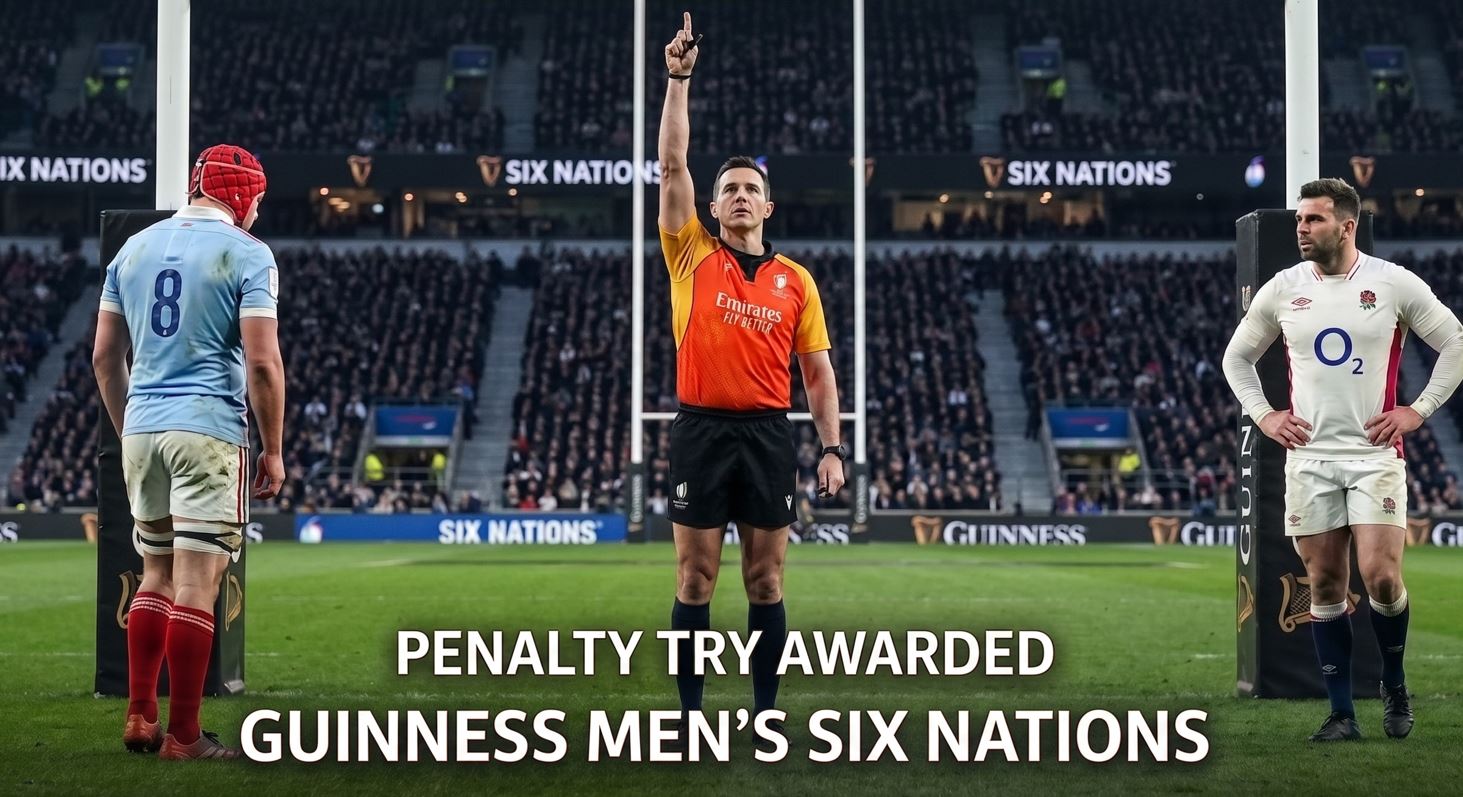
A penalty try is the most drastic decision a referee can make in rugby: seven automatic points, with no need for a kick, and a yellow card almost guaranteed. According to Law 8.3 of World Rugby, it is awarded when “a probable try would have been scored had it not been for the opponent’s foul play”.
In the recent 2026 Six Nations clash between France and England, this rule was at the heart of the drama. Was it a fair decision, or did the referees — once again — succumb to the pressure of the Stade de France? Let’s break it down.
What exactly is a penalty try? (The Golden Rule)
For the referee to raise his arm and point to the centre of the posts before the ball has touched the ground, two absolute conditions must be met:
- Cynical foul: A defender commits a deliberate foul (collapsing a maul, a high tackle, or playing the ball off the ground).
- Probability of a try: The referee must be convinced that, without that foul, the attacker would have grounded the ball. It does not have to be an absolute certainty — the ‘rugby gods’ do not demand that much — but it must be a clear probability.
Penalty Try vs. Conventional Try
| Feature | Penalty Try | Conventional Try |
| Points Awarded | 7 Points (Automatic) | 5 Points (+ 2-point conversion) |
| Conversion Required? | No (Directly awarded) | Yes (Kick must be taken) |
| Disciplinary Action | Yellow Card (Mandatory/Likely) | Situational (Depends on the foul) |
| Ball Placement | Under the Crossbar | Where the ball is grounded |
Case Study: The Ellis Genge Controversy (France v England 2026)
Watch from the 5:14 mark to see how the French maul powers forward and the exact moment when England’s defense illegally collapses the maul just before the try line. “Do you think the maul would have scored a try without the collapse? Let us know what you think in the comments.”
If you’re a fan of the England team, you’re probably still shouting at the telly. Ellis Genge’s tackle—that desperate attempt to halt the French advance on the try line—is a textbook example of why this rule is so subjective.
The referee ruled that Genge intentionally collapsed the maul to prevent the French from making the final push. My opinion? It was the right decision, even if it hurts. In modern rugby, if you kill the play 2 metres from your try line when you have the numerical advantage, you’re practically guaranteeing a penalty try.
What the experts say about Law 8.3
To understand the referee’s criteria, you have to go to the source. According to the official World Rugby Laws, the referee does not need to predict the future. They simply need to assess the timing and direction of the attack.
The public is often confused: it doesn’t matter if there was another defender 5 metres away. If the offender committed a professional foul that disrupted the immediate flow of the try, the penalty is maximum. It is a matter of the integrity of the game.
“A penalty kick is a matter of ‘probability’, not ‘certainty’. In this case, the French momentum was unstoppable.” — Nigel Owens, in his post-match analysis.
Factors that tip the referee’s balance:
- Distance: How close was the attacker to the try line?
- Coverage: Were there other defenders with a realistic chance of making a legal tackle?
- Nature of the foul: Was it a technical error or a blatant ‘professional foul’?
Is the penalty too harsh?
England head coach Steve Borthwick later acknowledged his team’s discipline issues: “We must avoid putting referees in positions where such decisions become necessary.”
The debate over whether a penalty try should be worth 7 points outright, without a conversion, is still raging in the pubs of London and Paris. Some say it takes the ‘art’ out of the kick, but — let’s be honest — it’s the only way to stop defenders from systematically cheating in their own in-goal area.
Next time you see the referee running under the posts after a collapsed scrum, you’ll know: it’s not a matter of opinion, it’s the strict application of Law 8.3.
While the penalty try was a pivotal moment, it did not settle the contest. The match ultimately turned into a spectacular attacking battle, concluding with the hosts lifting the 2026 Six Nations title. England was left to reflect on a match defined by fine margins—and one refereeing decision that will remain a talking point for years.
Do you think the decision against England was fair, or was it a ‘home town decision’ in France’s favour? Let me know in the comments.
Frequently Asked Questions: The Penalty Try Explained
A penalty try is the ultimate sanction awarded by a referee when a “probable” try has been prevented by an opponent’s misconduct. Instead of making the team fight for the line again, the referee simply points between the posts. No conversion kick is required — it’s an immediate 7-point boost to the scoreboard.
In Rugby Union, a penalty try is worth 7 points. This is a relatively recent change (introduced globally in 2017) designed to speed up the game by removing the need for a “formality” conversion kick. It’s worth noting that in Rugby League, the value differs, but for the Six Nations and international tests, it’s a flat seven.
World Rugby officially changed the law in July 2017. Before this, a penalty try was worth 5 points, and the team had to take the conversion kick from directly in front of the posts. The powers-that-be decided to eliminate the kick to save time — a rare moment of common sense in the ever-evolving rugby law book.
While the laws don’t explicitly use the word “automatic,” it is incredibly rare to see a penalty try without a trip to the Sin Bin. If a player’s foul was cynical enough to stop a certain score, the referee almost always brandishes a yellow card. It’s the “double whammy” that can break a team’s momentum, as we saw with the England vs. France controversy.
These are often confused, but they are very different animals. A penalty try is 7 points awarded instead of a try being scored. An 8-point try occurs when a player is fouled during or after successfully grounding the ball. In that case, the try is awarded (5 pts), the conversion is taken (2 pts), and then a penalty kick is awarded from in front of the posts (1 pt) as a disciplinary measure.
Opinions in the pubs of Twickenham might differ, but by the letter of Law 8.3, yes. If a defender (like Ellis Genge) collapses a maul or tackles early on a player about to score, the “probability” of a try is high. Referees are now coached to be less lenient with “professional fouls” near the try line to keep the game attacking and fair.