
- The Unexpected Call-Up: How Casey McLean Shocked the Rugby League World
- Casey McLean Eligibility Explained: Can a Kiwi-Heritage Player Represent the NSW Blues?
- Cultural Roots and Family Identity: What Iwi and Nationality Is Casey McLean?
- Casey McLean: Career Stats and Player Profile Summary
- What Happens Next
He wasn’t even supposed to play.
Casey McLean walked into Accor Stadium on May 27, 2026 as the NSW Blues 19th man — the one who fills water bottles, claps encouragingly from the warm-up zone and goes home quietly if nothing explodes. Except everything exploded. And rugby league suddenly had a new kind of Origin story.
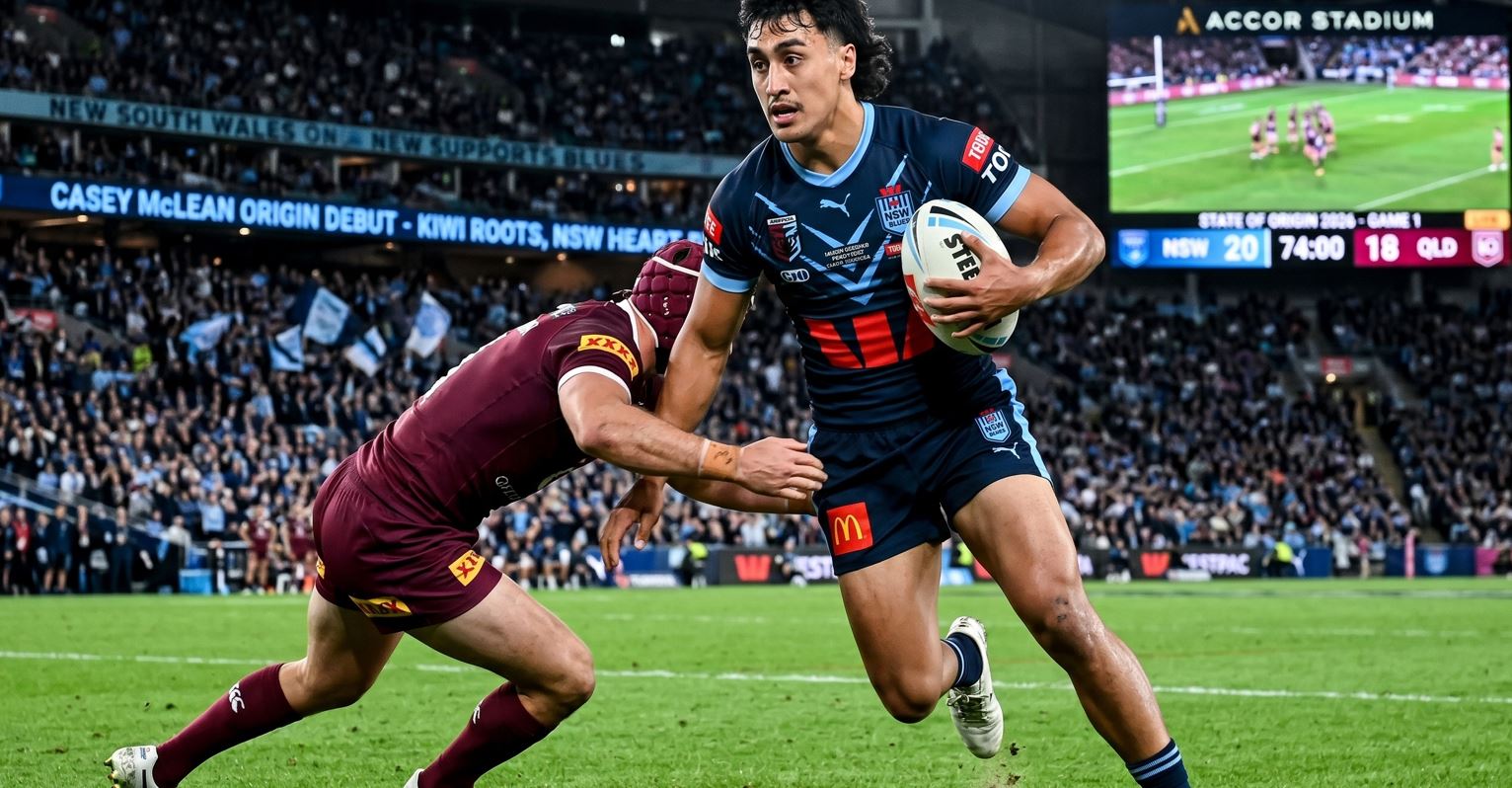
The Penrith Panthers centre didn’t just make his State of Origin debut on Wednesday night — he detonated it. Entering at the 57th minute after Tolu Koula failed his Head Injury Assessment following a high shot from Kalyn Ponga, the 20-year-old delivered the spark that ignited one of the most extraordinary comebacks in the 46-year history of the series. NSW — trailing 20-6 and staring down humiliation — conjured three tries in 18 breathless minutes to stun Queensland 22-20 in front of nearly 80,000 fans. The stadium went from funeral to carnival in under 20 minutes.
Short answer to the question dominating search engines from Sydney to Auckland right now: yes — Casey McLean is fully eligible to represent the NSW Blues in State of Origin. Despite his deep Kiwi heritage and international appearances for the New Zealand Kiwis, he was born and raised in Blacktown, NSW, and qualifies comfortably under the ARLC’s updated eligibility framework announced in February 2026.
The longer answer — his Māori roots, his Chinese heritage, his brother Jesse, and the precise rule change that made all of this possible — is exactly what this piece is for.
The Unexpected Call-Up: How Casey McLean Shocked the Rugby League World
No one planned for this to happen. Not Laurie Daley. Not the NSW selectors. Certainly not Casey McLean himself, who arrived at Homebush in the role of squad mascot — present, prepared, but not really expected.
Then Kalyn Ponga’s left shoulder changed the script entirely.
At the 57th minute, the Maroons fullback drove high into Koula’s head as the Manly winger broke down the left channel. Referee Ashley Klein made the call — send-off, first ejection in Origin since Joseph Aukuso-Suaalii in 2024 — and Koula failed his HIA moments later, unable to return to the field. Under the head injury replacement protocol, the Blues activated McLean as their 18th man. A kid who wasn’t expecting a single minute of game time suddenly had 23 of them — in State of Origin, with the series already on the line, 14 points down.
What happened next is the part worth telling.
McLean didn’t freeze. He didn’t look like someone experiencing the moment for the first time. He looked like someone who had always been there, waiting for the right door to open. His carries were direct and physical. His footwork in the right place at the right time. When he got involved in the build-up that led to Ethan Strange’s 63rd-minute try — cutting NSW’s deficit to 20-10 — the momentum of the entire match shifted. James Tedesco crossed for the winner with 90 seconds left on the clock.
Blues 22. Maroons 20. One of the all-time nights.
The dressing room told its own story. It was Isaah Yeo — the Panthers and NSW captain, a man who has played enough big games to know what fear looks like — who pulled McLean aside just before kick-off:
“You’ve done it all year, back yourself, back your training, just run out there, do your job and don’t let anyone down.”
Yeo, it’s fair to say, needn’t have worried.
Brian To’o, who’s watched enough talent pass through Penrith’s pipeline to separate the genuine articles from the noise, offered the sharpest verdict of the night: “Even with the amount of time he had on the field, it was not unexpected. He was ready for the moment. He’s built for this arena.”
That quote will age well.
For more on the match and McLean’s post-game reaction, see the full NRL.com debrief: The inspirational words behind McLean’s unexpected Origin debut.
Casey McLean Eligibility Explained: Can a Kiwi-Heritage Player Represent the NSW Blues?
Yes. Casey McLean is fully eligible for State of Origin and entitled to represent the NSW Blues.
But the “how” is important — because this isn’t just trivia. It’s the story of a rule that was broken for years, finally fixed in February 2026, and already producing its first great character.
The Old Rule — And Why It Was Absurd
Under the previous eligibility framework, the logic was almost comically punishing: if you had ever represented New Zealand or England at Test level, you could not play State of Origin — regardless of where you were born or raised. Full stop. No exceptions.
Kalyn Ponga had previously declined a Kiwis cap in part to preserve his Queensland eligibility. Casey McLean had publicly stated as recently as April 2026 that he represented New Zealand because “the door wasn’t really open” for Origin. Players were being forced to choose between their cultural identity and their state. It was a relic of an era when international rugby league barely existed as a meaningful competition.
The game grew. The rule didn’t.
The February 2026 Change That Made History
In February 2026, the Australian Rugby League Commission (ARLC) overhauled the framework entirely. The new rule is simple:
- A player is eligible for NSW or Queensland if they were born in that state, OR
- Resided in the state before their 13th birthday, OR
- Have a parent who played State of Origin
The critical new element: players no longer need to be available for Australian Kangaroos selection. Representing New Zealand or England at Test level no longer blocks Origin eligibility. You can wear the black jersey in November and the sky blue jersey in May. Both. At the same time.
“State of Origin is about where you’re from and what State you’re eligible for — not which country you represent internationally,” said ARLC Chairman Peter V’landys. “If you’re eligible, you should be able to play for your State.”
Casey McLean meets the criteria without ambiguity. Born on April 24, 2006 in Blacktown, New South Wales — raised through the Penrith junior system, through the Panthers’ Harold Matthews and Jersey Flegg grades, through the NSW Under-19 State of Origin side in 2024. He is, by every geographic and developmental measure, a product of New South Wales.
The full eligibility criteria are available at NRL.com.
What About the Kiwis?
McLean will continue representing New Zealand internationally — including, in all likelihood, the 2026 Rugby League World Cup. The rule change explicitly permits this dual representation. He is, in the most literal sense, the best argument that has ever been made for that rule change existing.
Cultural Roots and Family Identity: What Iwi and Nationality Is Casey McLean?
This question is trending — and it deserves a proper answer, not the vague non-reply most player profiles serve up.
Casey McLean’s heritage is proudly, deliberately layered.
He is of Māori descent through his father, Willie McLean — a New Zealand-born rugby league player who represented the North Sydney Bears in the NRL from 1997 to 1999, was a Marist Saints junior in Auckland, played for Waitakere City in the Lion Red Cup, and was selected for the Rest of the World representative team in 1997. Willie’s New Zealand roots run deep, and he raised his sons with a clear sense of where they came from.
Through his mother Shannon, Casey carries Chinese heritage. Shannon is the sibling of former NRL star Alex Chan — who played for both the Eels and the Storm — which makes Melbourne Storm edge forward Joe Chan Casey’s first cousin. The extended family trains together, eats together (chopsticks included, apparently), and plays rugby league together. It’s the kind of story that sounds almost too good to be true, except every detail checks out.
Born in Blacktown, Casey holds Australian citizenship and nationality — but his cultural identity has always leaned toward his New Zealand roots. When Kiwis coach Stacey Jones called in 2024, the answer came quickly:
“It came down to my family. The thought had crossed my mind that I can’t represent the junior clubs in Penrith — but at the end of the day the decision wasn’t too hard because I wanted to represent my family and where I came from.”
Regarding specific Iwi affiliation: McLean has not formally publicised which Iwi he descends from. What is clear — from his public statements, his cultural pride during Multicultural Round, and how he has spoken about his father’s influence — is that Māori identity is central to who he is and how he carries himself on and off the field.
And then there is the matter of Jesse.
The McLean Brothers: A Panther Dynasty in the Making
Jesse McLean, Casey’s older brother (born just 15 months earlier), also plays for the Penrith Panthers. They came through the club’s junior system together. They played side by side in the centres for the NSW Under-19 State of Origin side that won in 2024 — the same side. Brothers in blue, two years before Wednesday night.
Jesse was Casey’s first honest critic, by Casey’s own admission: “Jesse is the one that tells me the truth. I get perspective from the coach and staff, but he’s the last line of defence for me.”
That kind of fraternal honesty, coming through the same system, carrying the same family pride — it’s the foundational ingredient in what is shaping up to be one of the more compelling stories in Australian rugby league. Two brothers. One club. A heritage that stretches from Auckland to Blacktown and back.
Casey McLean: Career Stats and Player Profile Summary
For readers who want the data clean and current:
Player Profile
| Field | Detail |
|---|---|
| Full Name | Casey McLean |
| Date of Birth | April 24, 2006 |
| Age | 20 years old |
| Birthplace | Blacktown, New South Wales, Australia |
| Current Club | Penrith Panthers (NRL) |
| Contract | Signed through end of 2028 season |
| Position | Centre / Wing |
| Origin Debut | May 27, 2026 — NSW Blues vs. QLD Maroons (Game 1) |
| International Team | New Zealand Kiwis |
| International Debut | November 2024, Pacific Championships vs. Papua New Guinea |
| Father | Willie McLean (ex-North Sydney Bears, NZ) |
| Brother | Jesse McLean (Penrith Panthers) |
| Cousin | Joe Chan (Melbourne Storm) |
NRL Career Statistics
| Season | Club | Games | Tries | Points |
|---|---|---|---|---|
| 2024 | Penrith Panthers | 7 | 3 | 12 |
| 2025 | Penrith Panthers | 23 | 16 | 64 |
| 2026 | Penrith Panthers | 10 | 4 | 16 |
| Total | 40 | 23 | 92 |
In 2026 alone — before Wednesday’s Origin call — McLean was delivering four tries, seven try assists and an average of 146 run metres across 10 appearances. That’s not form. That’s dominance.
International Highlights (New Zealand Kiwis)
- Kiwis debut: Pacific Championships 2024 vs. Papua New Guinea — four tries on debut, becoming only the second player in Kiwis history to score a quadruple in his first Test match (after Brian Jellick, 1999)
- Age at Kiwis debut: 18 years and 200 days — third youngest Kiwi ever to represent the black jersey, behind only Dennis Williams and Thomas Leuluai
- 2025 Pacific Championships: Continued his international form, scoring in wins over Samoa
- Expected to be a core figure in the 2026 Rugby League World Cup squad under Stacey Jones
This is not a prospect. This is a finished product at 20 years of age — which is both thrilling and, if you’re a Queensland Maroons fan, genuinely unsettling.
Frequently Asked Questions
Yes. Casey McLean is fully eligible to represent the NSW Blues in State of Origin. Despite his strong Kiwi heritage and prior international appearances for New Zealand, he was born in Blacktown, NSW, and satisfies the ARLC’s residency and developmental criteria. The NRL’s rule change in February 2026 also removed the former restriction that barred players who had represented New Zealand or England at Test level.
Casey McLean carries both New Zealand Māori and Chinese heritage. His Māori descent comes through his father Willie McLean, a former NRL player born in New Zealand. His Chinese heritage comes through his mother Shannon, sister of former NRL star Alex Chan. His specific Iwi affiliation has not been formally disclosed publicly. He was born in Blacktown, New South Wales.
What Happens Next
Coach Laurie Daley made clear in his post-match press conference that Tolu Koula — if fit — retakes his spot on the left wing for Game Two at the MCG on June 17. McLean, almost certainly, returns to the bench. Super-sub. Impact player. The one who comes on when everything matters.
That might sound like a consolation prize. It isn’t.
The Maroons now know exactly what the Blues have coming off their bench. And the next time that gate opens and Casey McLean steps onto a State of Origin field, there’ll be 80,000 people paying very close attention to what he does next.
He wasn’t supposed to play on Wednesday night.
He played like someone who was always meant to be there.