
- Essential Rugby Moves Names & Vocabulary (Quick Reference)
- Best Rugby Plays for Beginners and Kids
- Top Backline Moves to Break the Defense (Union & NRL)
- Structured Phase Play & Forward Tactics (Advanced Coaching)
- Free Rugby Playbook Tools & Animation Resources
- Frequently Asked Questions about Rugby Plays
A team that understands rugby tactics doesn’t just move the ball —it owns the field.
Whether you’re watching the Wallabies dismantle a blitz defence at Stadium Australia or cheering your local NRL side punch through a flat line on a freezing Sunday morning, one truth holds across both codes: precision beats brawn, every single time.
This guide covers the best rugby plays from both Rugby Union and Rugby League (NRL) —from beginner moves your kids can run at Oztag training, to the advanced backline structures that decide test matches. No paywall. No registration. No static rugby plays pdf to lose in your downloads folder.
Essential Rugby Moves Names & Vocabulary (Quick Reference)
Before you execute anything on the pitch, you need to speak the language.
Knowing your rugby moves names isn’t about sounding impressive at training —it’s about communicating at full pace, when the defence is already moving and there’s zero time to explain.
Here’s your rapid-fire tactical reference:
Simple. Tactical. No rugby plays pdf required —just bookmark this page and come back before every session.
Best Rugby Plays for Beginners and Kids
Here’s what most coaching manuals bury under sixteen pages of jargon: the fundamentals of rugby plays for beginners are beautiful in their simplicity.
Australian youth rugby —from Oztag through to junior Club Union— is built on timing, space, and voice. Not collision. Not brute force.
These two plays are where every squad in this country should start. No exceptions.
1. The Basic Switch (Scissors Play) – Step-by-Step
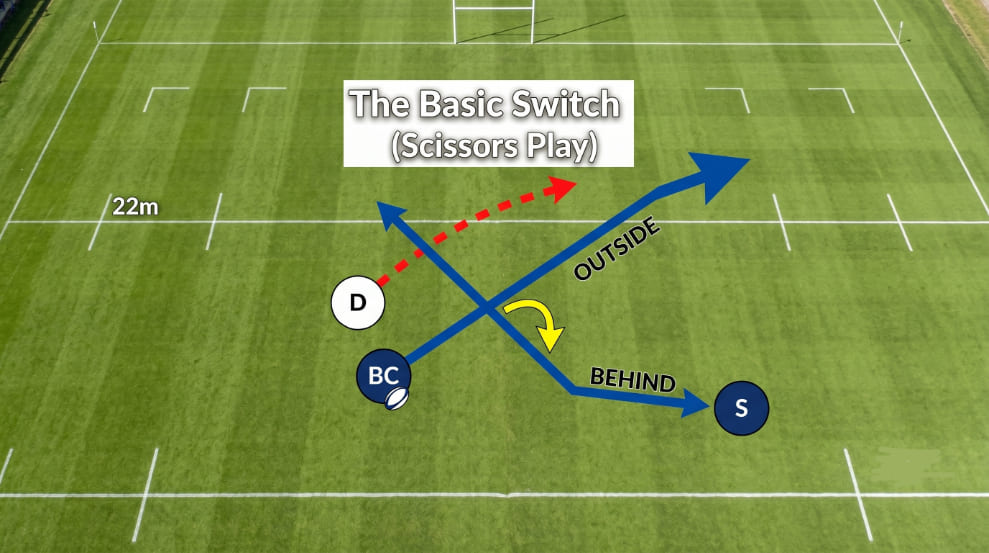
- Why it works: It exploits the most predictable instinct in rugby —defenders follow the ball carrier, not the space behind them.
- Execution:
- The ball carrier runs diagonally toward the outside, pulling their direct defender with them.
- The support player cuts sharply inward at an acute angle, crossing behind the carrier’s back.
- A short, soft, disguised pass hits the support at the exact point of intersection —before the defence can react.
Pro-Tip: This is the single best rugby plays for kids option because it builds two skills simultaneously: verbal communication (“Switch!”) and spatial awareness. Run it through a cone grid every single session until the timing becomes unconscious.
2. The 2v1 Draw and Pass Overload
The mathematics of rugby are unforgiving. Two attackers against one defender should always produce a try.
If it doesn’t —and we’ve all seen it fail on a Saturday morning— the timing was simply off.
- Execution:
- The ball carrier attacks the inside shoulder of the lone defender, threatening the gap and forcing a commitment.
- Wait. Don’t pass early. Let the defender’s weight completely shift toward the tackle.
- Once committed, deliver a firm, flat pass to the outside runner’s hands —not their chest, their hands.
Deceptively simple. Criminally underused at junior level. Master this before trying anything else.
Top Backline Moves to Break the Defense (Union & NRL)
This is where the game gets interesting —and where most coaching content either disappears behind a paywall or dissolves into diagrams that make no sense off the whiteboard. Not here.
These three plays function brilliantly in both Club Rugby Union and the NRL. That’s not a coincidence. Elite attack principles transcend the rulebook; only the context around them changes.
3. The Miss Pass (Skip Pass) to Exploit Wide Spaces
The blitz defence is everywhere in Australian rugby right now. It looks aggressive, it’s designed to impose psychological pressure, and it has one glaring, exploitable weakness: the wide channel.
Execution:
- The #10 receives and immediately scans the line. Blitz on? Green light.
- The #12 runs a hard, direct crash line —a pure dummy run— dragging one or two defenders inward and narrowing the defensive shape.
- The #10 launches a long, accurate pass over the shoulder of the #12, connecting with the #13 or wing in open space the defence has just vacated.
4. The Loop & Wrap Around Play
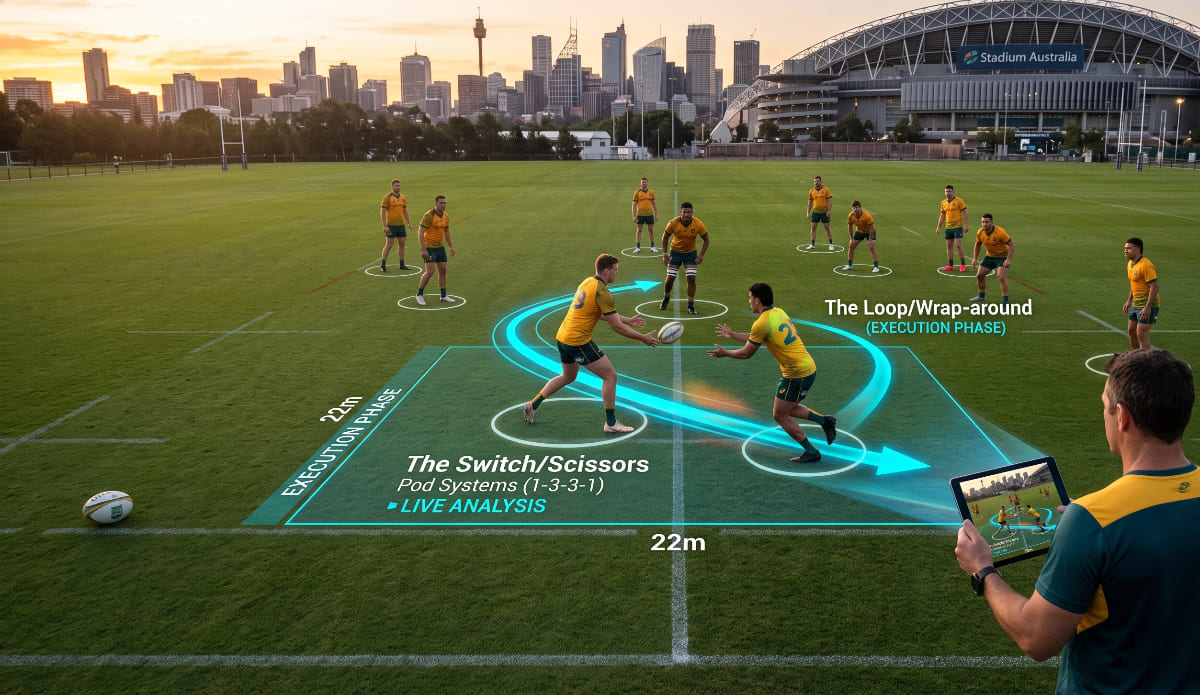
Think of this as a manufactured overlap. You create a two-on-one out of nothing —no extra bodies, no set piece, no forward carry. Just two players, one decision, and a bit of pace.
Execution:
- Player A passes to Player B and immediately accelerates around B’s outside shoulder.
- Player B draws the defender, takes a lateral step, and returns the ball to A —who arrives at full sprint as a completely unaccounted-for attacker.
- Instant 2v1. The defence has zero time to reorganise because the whole sequence happens in under four seconds.
5. The Crash Ball (The Battering Ram)
Not every play needs to be elegant. Sometimes you need to punch a hole through a defensive wall and recycle possession in under three seconds. That’s the Crash Ball —and done properly, it’s a precision weapon, not a panic option.
- Execution:
- The #10 takes a quick, flat ball from a ruck or scrum base.
- The #12 —or a forward joining the line at full sprint— targets the gap between two defenders, attacking the shoulder rather than the body.
- The objective isn’t to beat the tackle and keep running. It’s to fall forward, protect the ball on the ground, and give the next carrier a platform in under 3 seconds.
In the NRL, you’ll see this used to control field position on the fourth tackle before a kick. In Union, it’s the engine that generates go-forward ball for wide backline plays. Two codes. One weapon. Unlimited applications.
Structured Phase Play & Forward Tactics (Advanced Coaching)
This section isn’t for the casual fan. It’s for coaches who are tired of improvising and want to build something repeatable —something that actually works under pressure in the 70th minute.
6. Pod Systems (1-3-3-1 & 2-4-2 Formations)
Pod play is simple in concept: distribute your forward bodies across the width of the field so you’re never caught without a cleanout crew near the breakdown.
In a 1-3-3-1 system:
- Forwards split into three horizontal pods across the field, with one sweeper working behind the ball.
- Each pod drives for territory, secures the ruck, and releases before the defence sets a new line.
- The result: relentless forward momentum with a low turnover risk —because there’s always a body where the ball lands.
The Wallabies leaned heavily on pod structures through their recent international campaigns. While execution details vary, the core strategic intent remains the standard for modern phase play.
7. Set-Piece Attack Patterns: Union vs. League
Understanding which code you’re coaching changes every decision you make in attack design. Mixing them carelessly is how you end up with a system that works in neither.
Free Rugby Playbook Tools & Animation Resources
Forget downloading a static sheet of free rugby plays and printing it at 60% scale on a blurry A4 page.
Australian coaches in 2026 are designing, animating, and sharing tactics directly from their phones —before kickoff, at halftime, and mid-week.
Here are the two tools that actually deliver:
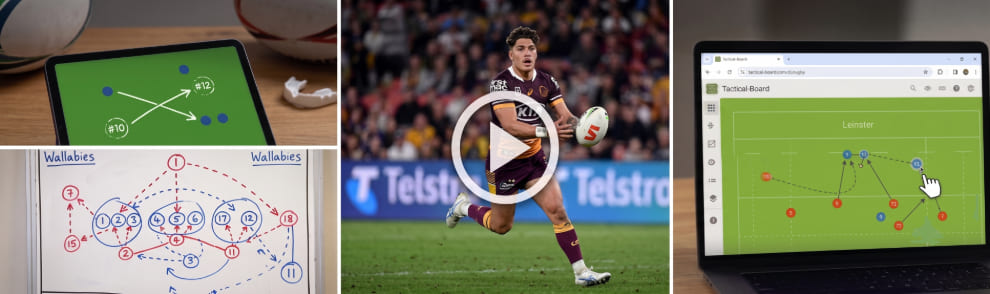
- Tactical Board Online: Hands down the best rugby playbook creator free option available right now. No download, no sign-up, no credit card. Draw your ruck shapes, position your pods, and share a live link straight to the team’s WhatsApp group. It takes about 90 seconds pitchside to build a play and send it.
- Sportplan: The gold standard if you want a genuine rugby play animator free trial. It features full 2D movement animation with a built-in drill library and easy share links for pre-game emails. The premium tier exists, but the free version covers most grassroots coaching needs without the headache of a subscription.
Neither tool requires a printer. Neither requires a pdf. Both require ten minutes to learn —and will save you hours at the whiteboard.
Frequently Asked Questions about Rugby Plays
The most widely used and effective rugby plays are: The Switch (scissors crossing pattern), The Loop (wrap-around manufactured overlap), The Miss Pass (skip pass to exploit wide space), The Crash Ball (direct forward penetration) and kicking plays such as the Grubber Kick and Cross-field Kick. These appear at every level of Rugby Union and Rugby League (NRL) competition across Australia.
Core rugby terminology includes: Ruck (ground-level contest for possession), Maul (standing ball-and-carrier contest), Scrum (contested set-piece restart), Lineout (throw-in from touch), Play-the-ball (League restart mechanic after a tackle), Cleanout (removing defenders from the ruck area), Offload (pass made inside or after a tackle) and Dummy (a faked pass to freeze the defence).
In Rugby Union, the number 7 is the Openside Flanker —arguably the most physically relentless position on the field. Their job is to tackle everything that moves, contest every single breakdown, and specialise in the “jackal” (legally stealing ball on the ground). In the context of the shortened code, “7s play” refers specifically to Rugby Sevens: seven players per side, full-size pitch, and a pace that makes XV-a-side look pedestrian.
Technically, infinite —because tactical variation has no ceiling. But in practice, every rugby play ever run at any level is a variation of five core attack structures: direct penetration (Crash Ball), crossing runs (Switch/Scissors), wide delivery (Miss Pass), manufactured overlap (Loop), and numerical advantage through draw (Draw and Pass). Master those five and you can read, design, and counter almost any play in the game.
For a deeper breakdown of elite backline structure in Rugby Union, World Rugby’s official coaching resources provide internationally accredited drill frameworks used by national federations including Rugby Australia. It’s free, it’s authoritative, and there’s no reason not to have it bookmarked.